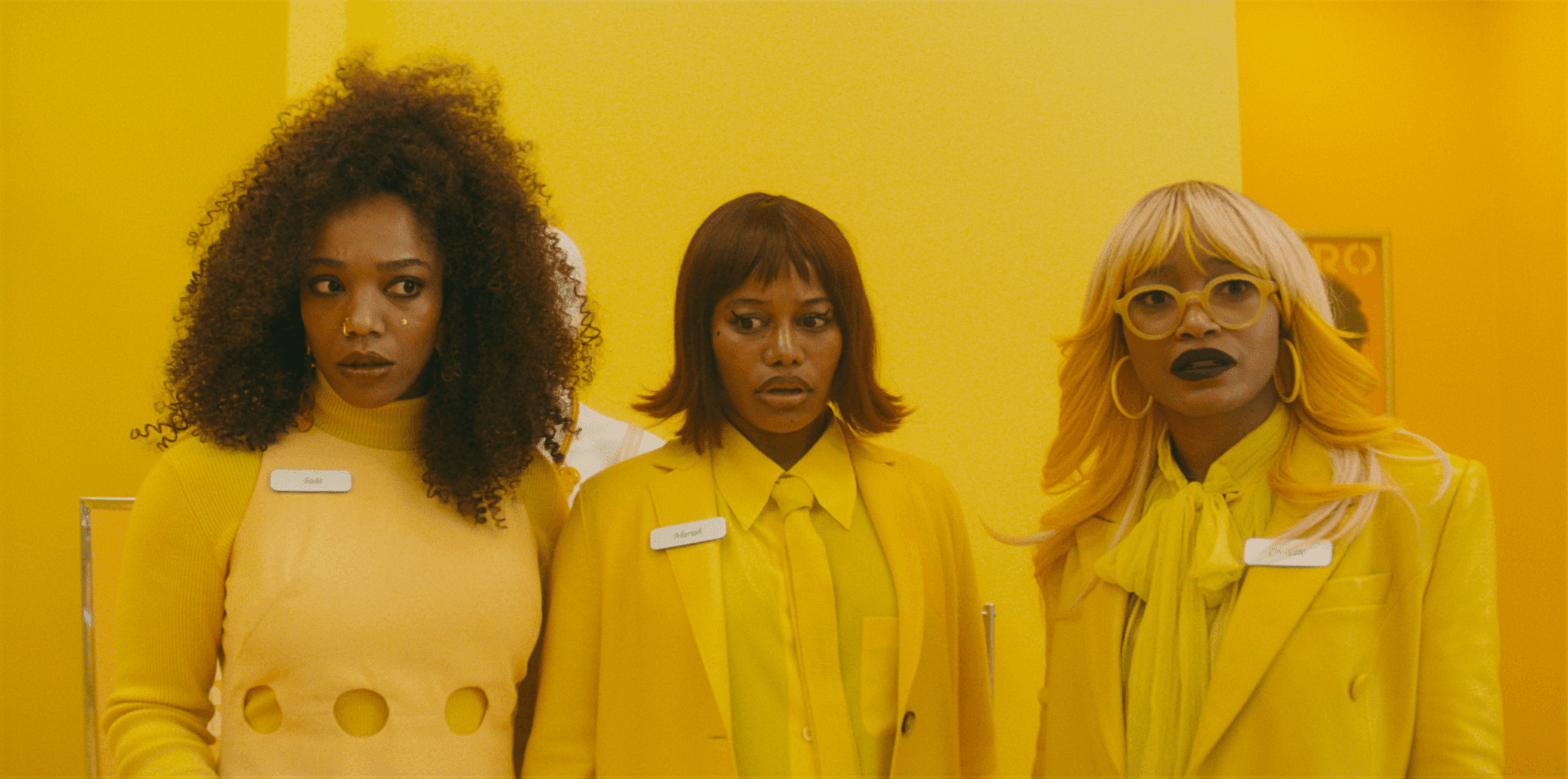
From I Love Boosters (2026), dir. Boots Riley, courtesy Neon.
(Essays)
Everything You’ve Heard Is True
Issue 011
OCTOBER 20, 2026
In the opening scene of Boots Riley’s surrealist manifesto against capitalism, I Love Boosters (2026), the camera struts and sways to the rhythm of Keke Palmer’s character, Corvette. We move with her as she grooves her way to the dance floor, pauses to look in the mirror at her Black femme face, and scans the room. She exchanges desirous glances with a couple of men and takes one home after pointedly asking his shoe size. When we arrive at her apartment, lined wall-to-wall in clothes and accessories, there’s little doubt what she’s after: his capital in exchange for a pair of shoes she’s stolen, or boosted.
In Juel Taylor’s 2023 film, They Cloned Tyrone, another Black woman is on a quest for a come-up. Teyonah Parris’s Yo-Yo charts paths of economic and psychological liberation for those in her neighborhood of the Glen and those in other Black communities targeted by a sinister plot. Without her, insecure pimp Slick (Jamie Foxx) and depressed drug dealer Fontaine (John Boyega) languish in their disconnected and self-destructive lives. Both are as deep in denial as the brotha in the I Love Boosters opening who can’t even be truthful about his shoe size.
Satire trades in fabrication. The candy-coated costume design of I Love Boosters and the futuristic underworld of They Cloned Tyrone make that clear. Surrealism ensures that a political message hits different. Radical honesty does not whisper its arrival in these films, nor do the real-world oppressions they address.
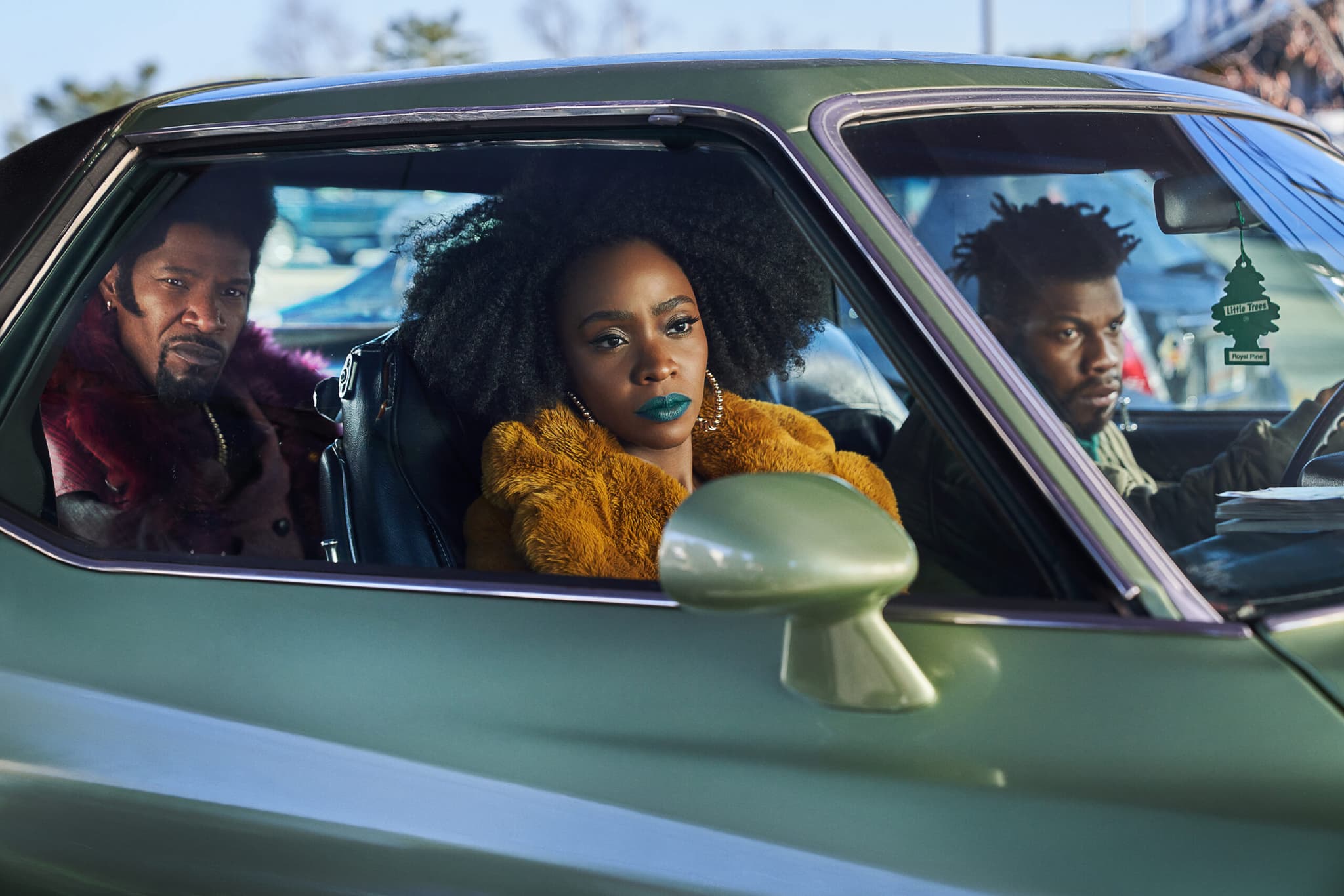
From They Cloned Tyrone (2023), dir. Juel Taylor, courtesy Parrish Lewis/ Netflix, Inc.
While these films are directed and mostly written by Black men, they are steeped in Black feminisms. What Corvette and Yo-Yo know is what the authors of the 1977 Combahee River Collective Statement knew. They know what Fannie Lou Hamer knew when she said, “Nobody’s free until everybody’s free.” Black women sit at the intersection of multiple oppressions; we have a perfect view of what imperialism, fascism, capitalism, racism, sexism, and other multilayered -isms can destroy. Still, traditionally, most popular satirists are men—a fact that became all too clear as I searched for cross-genre models when drafting my satirical novel, A Very Special Episode. Although the surrealist movement of the early to mid-20th century was dominated by male artists and theorists, Caribbean writers Suzanne Césaire, Simone Yoyotte, and later M. NourbeSe Philip were integral to its development.
In Adamma Ebo’s Honk for Jesus. Save Your Soul (2022), Aleshea Harris’s Is God Is (2026), Rungano Nyoni’s I Am Not a Witch (2017), and even as a device in her follow-up, On Becoming a Guinea Fowl (2024), satire is a setup for the sometimes-painful but necessary truth. In I Am Not a Witch, it is fear of powerful Black women and girls that lands the central character, Shula, in a witch camp, tethered to the place by ribbons and welcomed with a song’s indoctrinating lyrics of “We’re soldiers for the government. We’re used to it and don’t get tired.” Here she is given care and community by the other “witches,” until she wearies of the weight of misogynistic expectations. In On Becoming a Guinea Fowl, another Shula relieves her burden of patriarchy by crying out with the call of the African bird in the title, surrounded by other Black women and girls who have been victimized.
Whether it’s in a marriage, a family, or a community, the Black girls and women behind and in front of the screen want what’s real, even if it comes to them on a platter of absurdism. But that too is a bone-deep understanding for Black women: The real world is absurd, filled with doublespeak and rules that apply to some but never to others. From the shell game of capitalism to the fetid ideological foundation of anti-Blackness, Black feminists assure us that everything we’ve heard about what’s wrong with the world is true.
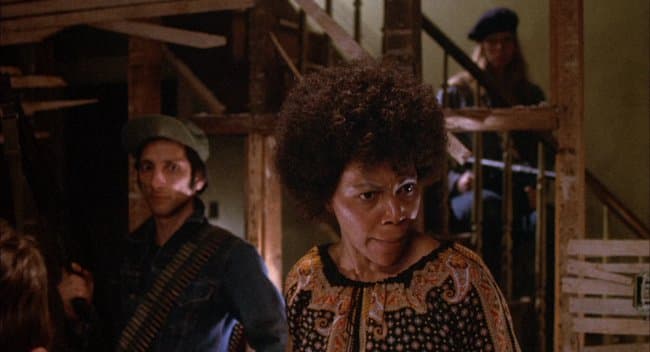
From Network (1976), dir Sidney Lumet, courtesy Amazon MGM Studios.
However, Black feminism is not to be confused with the presence of Black femmes in a film. Paul Thomas Anderson’s One Battle After Another (2025) is populated with the bodies of powerful Black women, Teyana Taylor, Regina Hall, Chase Infiniti, Starletta DuPois, and Junglepussy, and yet the muddled and mealy message is antithetical to the full-throated politics of many Black women. The Black radicals in One Battle After Another tote plenty of guns but not a single rhetorical weapon.
Fifty years ago, Paddy Chayefsky and Sidney Lumet delivered a diaphragmatic film about corporate greed and the basest inclinations of capitalist-driven media. Their film Network (1976) hinges on the proselytizing of white male news anchor Howard Beale (Peter Finch). Meanwhile, Laureen Hobbs (Marlene Warfield), a Black woman and member of the radical Ecumenical Liberation Army (ELS) who hosts USB-TV’s incendiary The Mao Tse-Tung Hour in the film, fights for a larger percentage of money in her television contract. If she and the ELA are going to be used to get higher ratings for the white corporate elite, her politics can at least briefly be her power.
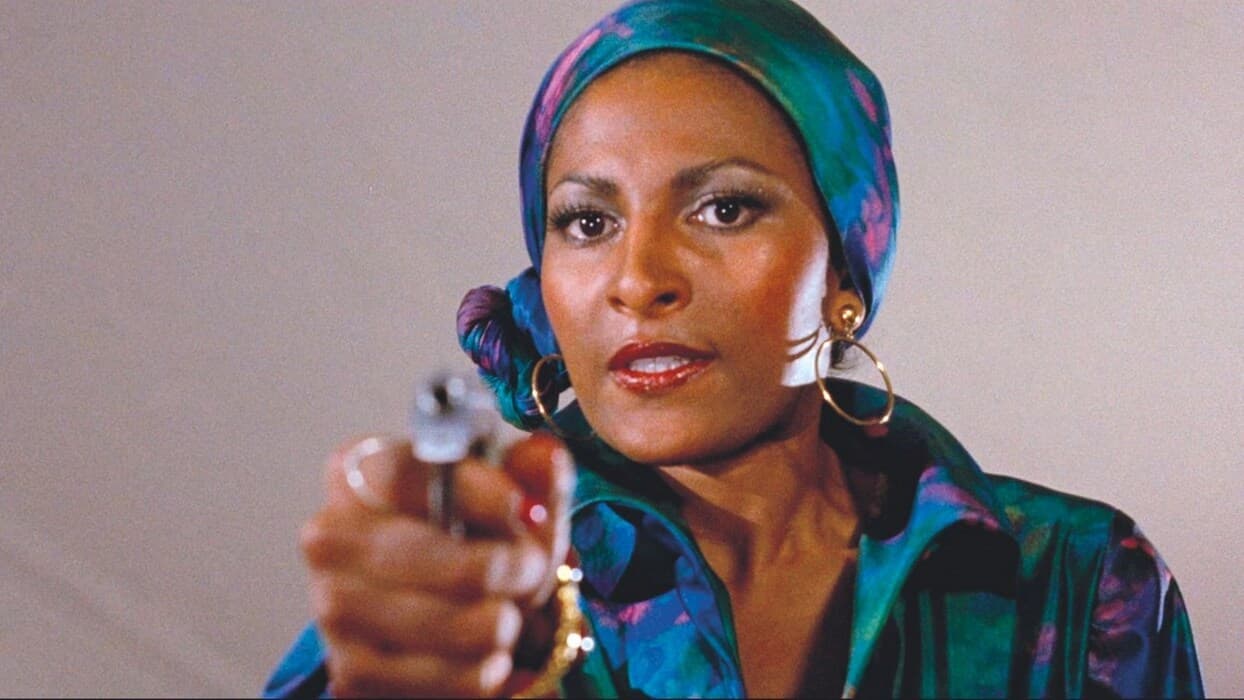
From Coffy (1973), dir. Jack Hill, courtesy Metro-Goldwyn-Mayer Studios Inc.
It was also in the 1970s that Black women leads like Pam Grier flexed their power in over-the-top films of the Blaxploitation era. Those movies also dabbled in the absurd, from the outfits to the dialogue, shoot-outs, and conspiracies. White audiences may have even seen Grier and Tamara Dobson as unrealistic choices for saviors, but for Black people, Black women as ass-kicking heroines didn’t feel surreal, only true.
Black feminism knows the urgency of transforming a broken world. Subtlety can be misconstrued. Subtlety can be dangerous. So the manifesto is never toothless, gently gnawing on the oppressions. We get bitten, and we bite back. It’s what Corvette—in solidarity with two other Black women who are her best friends, along with an Asian woman and a Latinx woman—does in I Love Boosters. They use every trick and tool at their disposal to fight against the exploitation of workers and a powerful cabal on the wrong side of identity politics. It’s what Yo-Yo and the other Black women sex workers in They Cloned Tyrone do. All are seeking an escape hatch, to “hit a lick” as Corvette puts it. They want to escape their circumstances. They have dreams and plans. Yo-Yo wants to head to Memphis and be a real-life Black Nancy Drew. They have so much in them they have not yet been able to unleash. It would be easier for Corvette and Yo-Yo to go for theirs, but they know all too well the community they would leave behind. Or as Violeta (Eiza González) in I Love Boosters tells Corvette and her girls: “We’re on the same side of the contradiction.”
Black feminists fear no contradiction, because, if we must, we can hold them all. We already do, our very presence churning, upending, and destabilizing every system that holds us down. For us, for all the Yo-Yos, Corvettes, and Shulas, truth seeking is a full-time ideology. It’s capacious enough for the real, the surreal, and the absurd, all in service of the revolution yet to come.
Share
Related