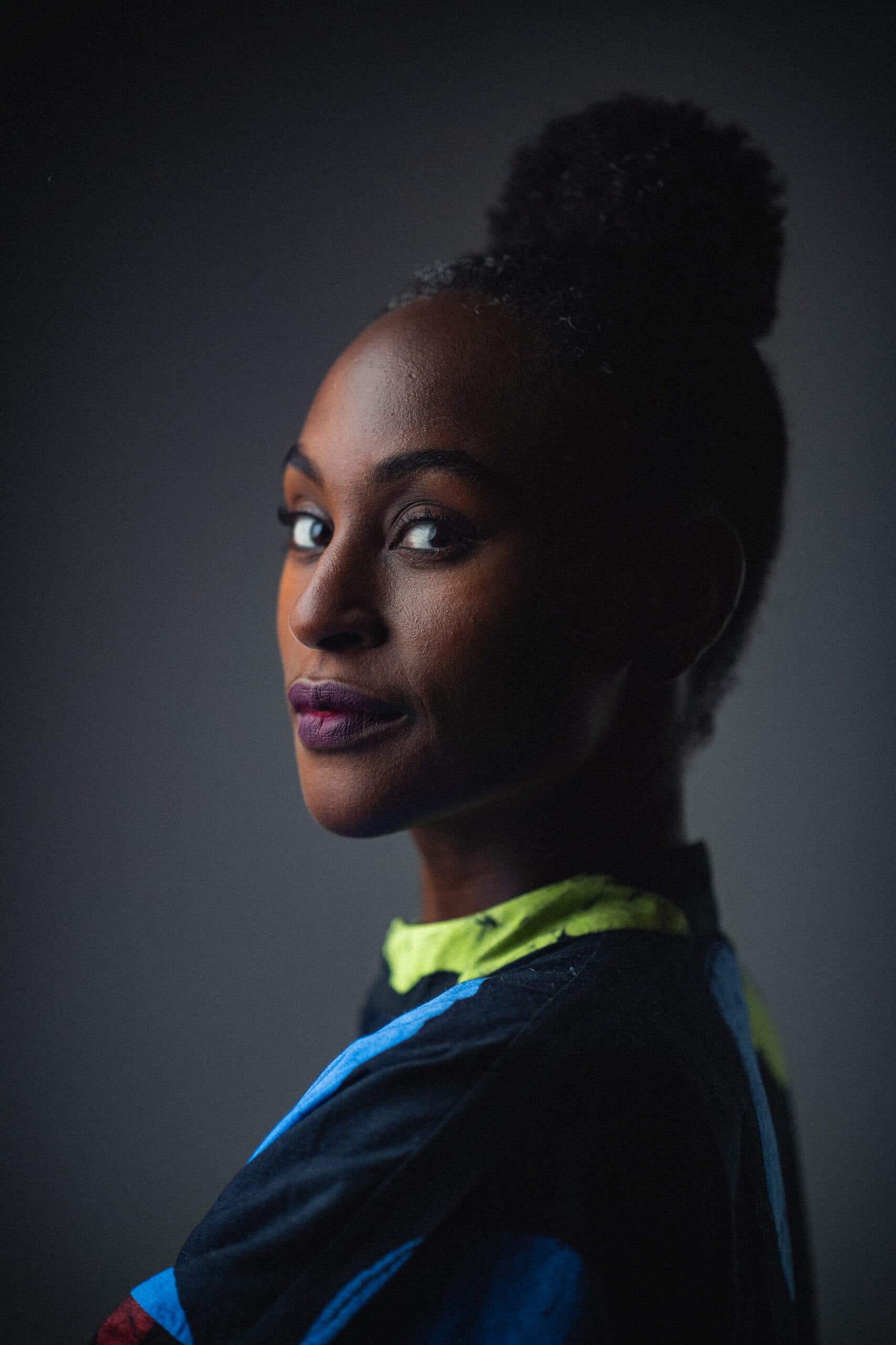
Lauren Tate Baeza photographed by Steve West.
(Interviews)
Reframing Modern Nigeria
Issue 011
OCTOBER 20, 2026
Few museum curators are reshaping how American institutions present African art as thoughtfully as Lauren Tate Baeza. Since joining the High Museum of Art in 2020 as the Fred and Rita Richman Curator of African Art, Baeza has reinvigorated the museum’s presentation and collection of art from the continent, which features significant holdings from Nigeria, the Democratic Republic of the Congo, and Côte d’Ivoire.
Over the past five years, Baeza has overseen a collection of over 1,000 works spanning ceramics, textiles, sculpture, photography, and material culture; organized acclaimed exhibitions such as Bruce Onobrakpeya: the Mask and the Cross, Ezrom Legae: Beasts, and Three Decades of Democracy: South African Works on Paper; and expanded the High’s collection of 20th-century art. Trained in African political history and cultural geography, Baeza previously served as director of exhibitions at the National Center for Civil and Human Rights and worked with NGOs and policy think tanks focused on efforts in Uganda, Kenya, Nigeria, and Malawi.
Rather than attempting to broaden the collection through representative acquisitions from across Africa, Baeza has homed in on the collection’s strengths, identifying existing gaps and addressing them through research and acquisitions. It’s a curatorial approach that privileges depth over breadth and has characterized Baeza’s tenure at the museum. In contrast to collecting strategies informed by market value or established artistic canons, Baeza’s practice is guided by historical inquiry. She views acquisitions as tools for constructing richer narratives about the people, politics, and cultural traditions that shape a particular place and time.
Twentieth Century Nigeria, part of a major reinstallation of the High’s African art galleries that highlights modern Nigerian visual culture, opens in October and represents the culmination of Baeza’s initiatives. While the High’s Nigerian holdings represented a rich collection of 20th-century material culture, it lacked the fine art that could contextualize the country’s artistic and historical development. The reinstallation reflects Baeza’s insistence that museums present African art not as a static record of the past but part of a continuum of living traditions. By placing 20th-century Nigerian fine art alongside material culture produced during the same period, Twentieth Century Nigeria reveals how different forms of artistic production reflected, responded to, and were shaped by the social and political transformations of the era.
Ahead of Twentieth Century Nigeria’s opening, Elodie Saint-Louis spoke with Baeza about her fascination with 20th-century political and social movements and what it means to be a custodian of history.
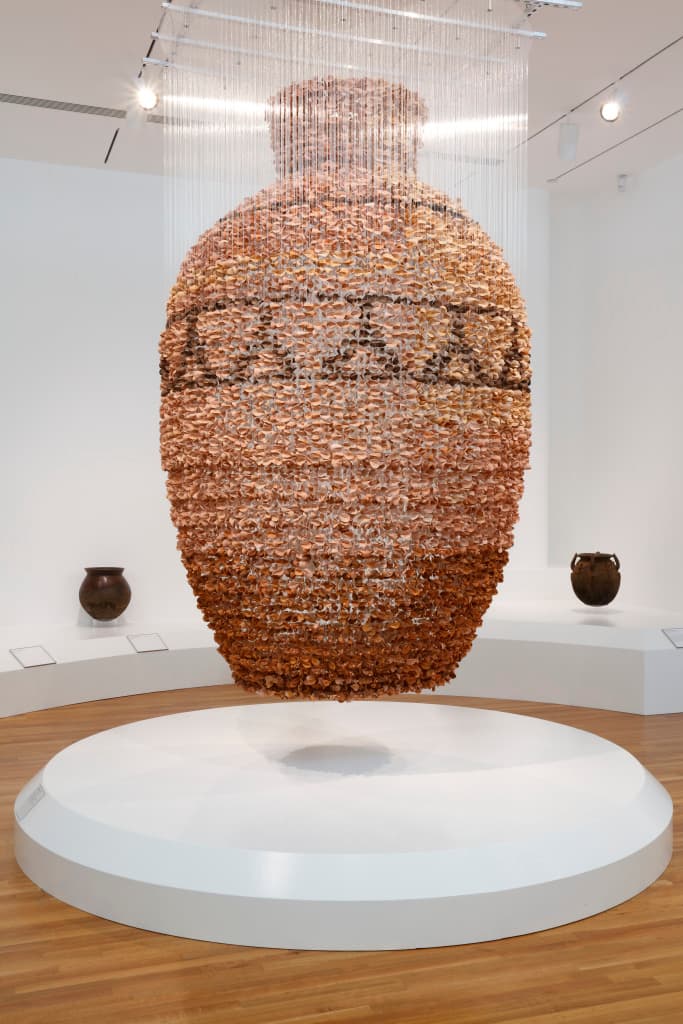
Ngozi-Omeje Ezema, Togetherness, 2022, ceramics, acrylic, monofilament fishing line, metal, © Ngozi-Omeje Ezema, photo by Mike Jensen.
Elodie Saint-Louis: I would love for you to start at the beginning for me. How did Twentieth Century Nigeria come about?
Lauren Baeza: I realized that Atlanta had all these incredible connections to Nigeria. Lagos has been a sister city since 1974. We have one of the largest Nigerian-born communities in the United States. And I [thought] we could really lean into this distinction a little further and accurately claim that we have one of the best collections of Nigerian art in the US. The opportunity was in 20th-century fine art because we have a lot of 19th- and 20th-, mostly 20th-century cultural objects, functional objects, many of which are said to have spiritual function.
ESL: You chose to structure Twentieth Century Nigeria around three outposts of the Nigerian College of Arts, Sciences, and Technology—Zaria, Ibadan, and Enugu—that offered post-secondary diplomas in art. [Note: The names of these outposts evolved over time; Zaria became absorbed into Ahmadu Bello University, the Ibadan campus became University of Nigeria, Ife and later Obafemi Awolowo University, and Enugu became the University of Nigeria, Nsukka.] Why did you decide to use these three schools as the organizing principle?
LB: It starts with what our collection suggests. We have a number of works in our collection by Bruce Onobrakpeya. He’s kind of the outlier in the sense that he was a really important Nigerian 20th-century fine artist, sculptor, and printmaker in particular. And Bruce is one of the most celebrated artists in Nigeria. He’s still alive. He’s in his 90s, and we really had a unique opportunity to do an exhibition of his work. I needed to respond quickly, so I proposed the Bruce Onobrakpeya show, and we looked at his work in the late 1960s, when he was doing commissions for the Catholic Church. So we have Zaria because of Bruce.
We also had a lot of works representing Nsukka. Probably one of our most beloved works at the museum is an El Anatsui piece, and he taught at Nsukka for over 40 years. I think he only recently retired. And so even though he’s a Ghanaian-born artist, he’s very important to the story of Nigerian art in the 20th century. He was working underneath Uche Okeke. Uche Okeke had also originally gone to Zaria and then became head of the Fine Art Department in Nsukka after the Biafra War.¹
We also have a number of Osogbo artists. They’re not a part of the Nigerian College of Art, Science, and Technology. They’re kind of a self-taught art movement, a Bohemian art movement that happens concurrent with these other things.
The other thing that I thought was really interesting about the Nigerian College of Arts, Science, and Technology is because it was founded by the colonial government. It was established as a school where you could get post-secondary training in a number of things, including an art diploma. And then it continues as all of these things are being reconciled and this major political transition is happening. So there’s this interesting opportunity to showcase the change from colonialism to early post-colonialism and even into the 21st century, because all of these schools still function. They become full universities in the early post-colonial period, offering full courses and degrees. And so these campuses become larger, more comprehensive spaces in these newly independent countries, to produce the next generation of properly trained degree-holding artists and practitioners of all kinds.
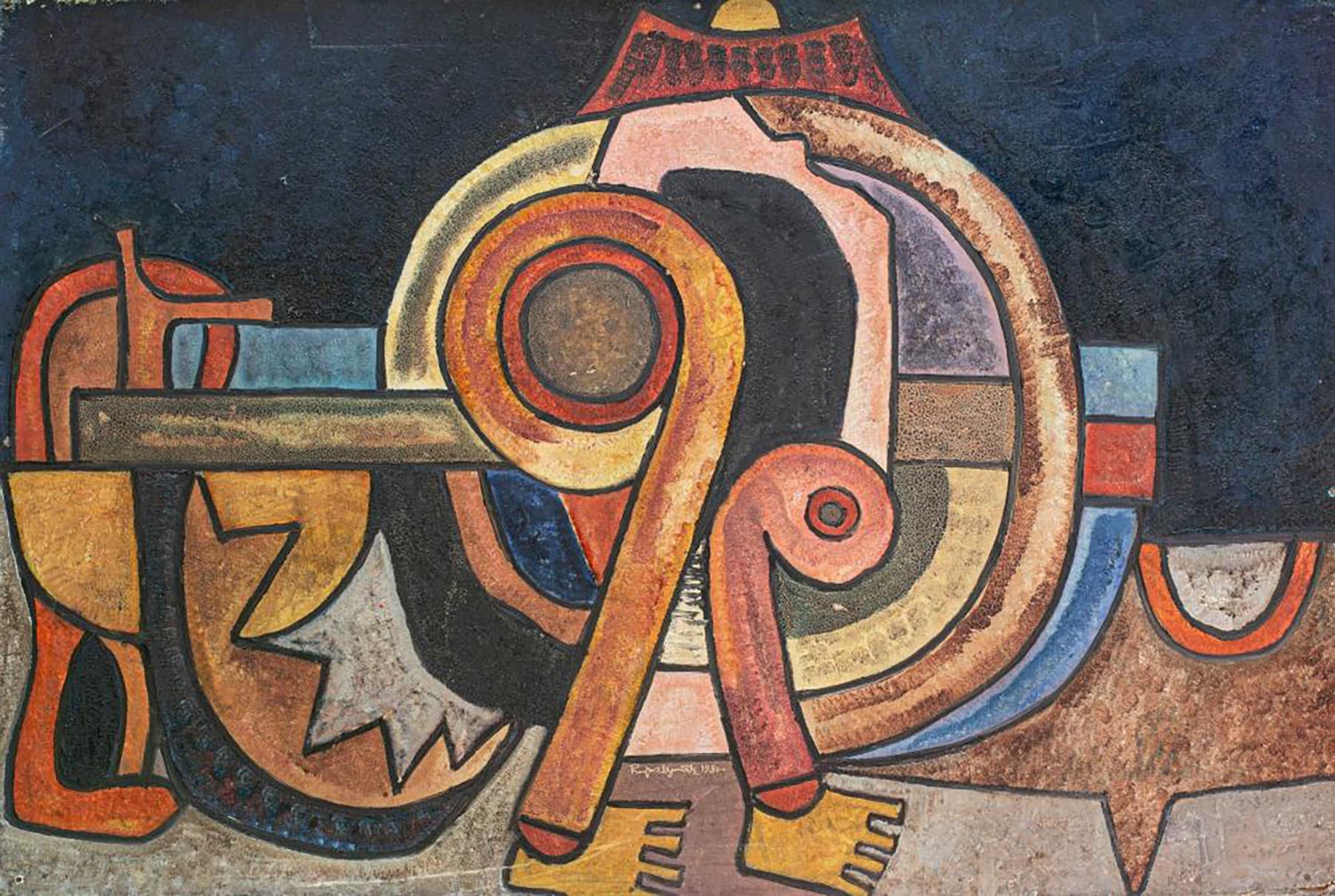
Rufus Ogundele, Untitled, 1984, acrylic on board, © Rufus Ogundele, image courtesy kó.
ESL: I’d love to know more about the distinctions between the schools and perhaps how the regions in which they were located influenced the particular traditions that emerged or if one was known for a particular type of artmaking.
LB: The school at Zaria became known as the school that birthed this aesthetic philosophy called natural synthesis, to visually create an amalgam of the influences of European training that they had had with Nigerian aesthetic values. So this kind of marriage is really interesting politically, because Nigeria didn’t fight a war for its independence. It was a very diplomatic exercise. There were a lot of compromises and negotiations. And I always think about how this lines up with the compromises, quote unquote, and negotiations of the art that they were producing.
To have proposed a complete return to pre-colonial aesthetic values and painting and techniques would not have been authentic anyway, because the truth was that everything was completely transformed, and this new Nigeria project was a new thing. And so I think visually this is like a way to try to articulate the time and this sort of thoughtful integration of influences—and to present them not as something that clashes but something that can be born anew, just like the nation was being born anew.
ESL: Can you mention a specific artist?
LB: Demas Nwoko, for instance, was in the Zaria School. He’s one of the people known as the Zaria Rebels or the Zaria Art Society, and he became an architect. You have printmakers and sculptors and architects trying to work out this natural synthesis idea and the design of things beyond even just visual art, but in how spaces are being designed in the early post-colonial period. That’s what Zaria is known for right as colonial rule is ending and right as independence is new and people are trying to articulate what Nigeria is in this moment. And so we’re talking the very end of the ’50s and early ’60s. And a lot of the people that come out of that program at that time become teachers and mentor the next generation of artists.
And it transforms there into several years of uli-grounded sort of frameworks for the fine art program. Uli is like a curvilinear mark making that traditionally belongs to women. It’s used in the indigenous and vernacular architecture of southeastern Nigeria among Igbo people. It is also used in women’s body decor, markings on the body and markings on buildings. The thing about these markings on the body, obviously, is they fade over time, like henna. And the buildings—the paint was not weather resistant. So everything’s kind of ephemeral. It washes away. So this uli tradition is not heavily documented. And so [Uche Okeke] taking uli, a tradition that isn’t tangible, and making it the center of the art program’s design ethos renders it more permanent.
Later the program became what it is now, which is celebrated [for its] creative use of materials and artists that stretch how far you can push materials that are not created to be art materials. That’s where you can think about artists like El Anatsui making these beautiful tapestries out of bottle caps.
But many artists at Nsukka do those kinds of things, whether it be plastic bottles or even when they are using traditional materials, like Ngozi-Omeje Ezema. She’s a ceramic artist who makes these massive mobiles of hanging pieces of clay and has them at different elevations so they form the shape of a vessel. So she’s making a vessel with the material that we associate with pottery, but it is an abstracted sort of dense mobile that is suspended in air. We’re not privileging one region over another. We’re not privileging one ethnic group over another. And those kinds of politics are really important in the geography of Nigeria.
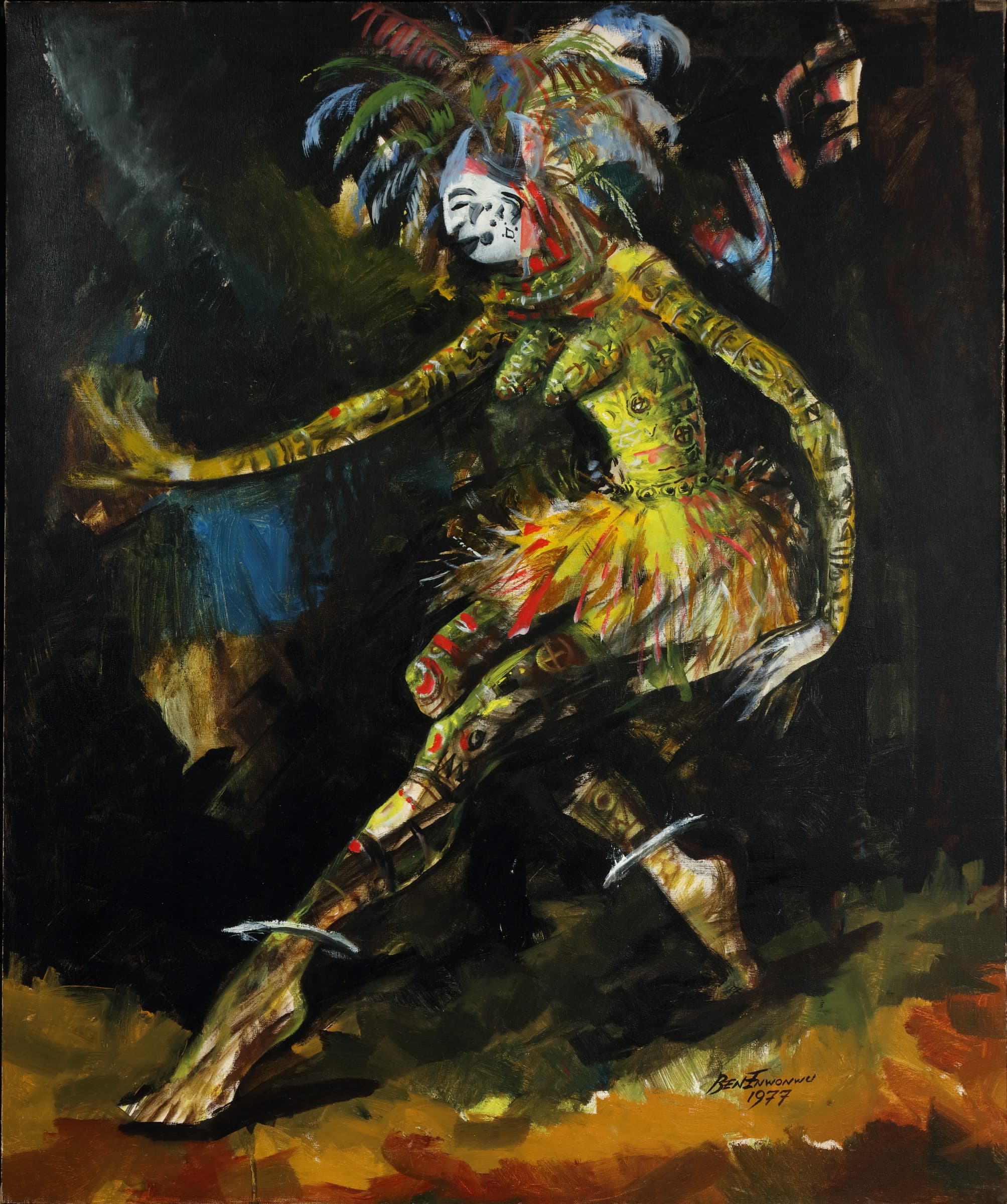
Ben Enwonwu, Agbogho mmuo, 1977, oil on canvas.
ESL: To bring African art into the entirety of the museum, to say that this art from this region is not isolated but there are so many cross-cultural connections, is really impactful.
LB: Even people like Charles Counts, who is an American potter who’s collected in other departments at the museum. He taught at Zaria for a while. So to go back to him and put the Zaria symbol so people can really see these connections—that’s really exciting. That’s really going to be just an opportunity for clarity too for us.
ESL: But that’s a very specific choice, right? Even coming into your position as curator is this act of listening to what the collection is telling you rather than you coming in and being like, OK, I want to completely erase what has come before me. I think that speaks a lot to your particular approach.
LB: I think it’s really important, because it’s a waste, really, to start all over again. Why not build on top of what everyone has been working towards, whether they were doing it intentionally or not? This is the history of the institution. “How do I make everything that’s happened before me more meaningful?” is much more useful and gratifying personally, in my opinion, than starting completely from scratch. I mean, there’s still so much work to do, even if you are taking into account what you’ve inherited. And you still have so much autonomy within that. You can respond to the collection and then have agency within how you respond to the collection.
ESL: I think we are also in this time of restitution or reparations within institutions, and I think there’s this urge to throw out everything that came before as if we can’t learn from history, that we don’t need to look at history in order to build something new. It’s as if our ancestors never thought about the things that we were trying to figure out right now. I think a strong throughline for me is this deep acknowledgment of tradition, of history, of listening.
LB: I’m happy to see incredible contemporary artists, and I celebrate them and love them and will program them for exhibitions. But I think in the research institution and [the] permanent collection, I would rather dedicate my time towards going back and making sure that we’ve done a little bit better by history, especially in these geographies. They’ve just missed so much. And it wasn’t until recently that lots of different voices were able to discuss history. So I think the immediate history is so much more important to go back and correct and fill in, because it is so connected to our realities now. I think we can learn an awful lot from the last 50 to 100 years to guide us through what’s going to be a very difficult 21st century. And if we don’t understand it, we aren’t going to be equipped with the tools we need.
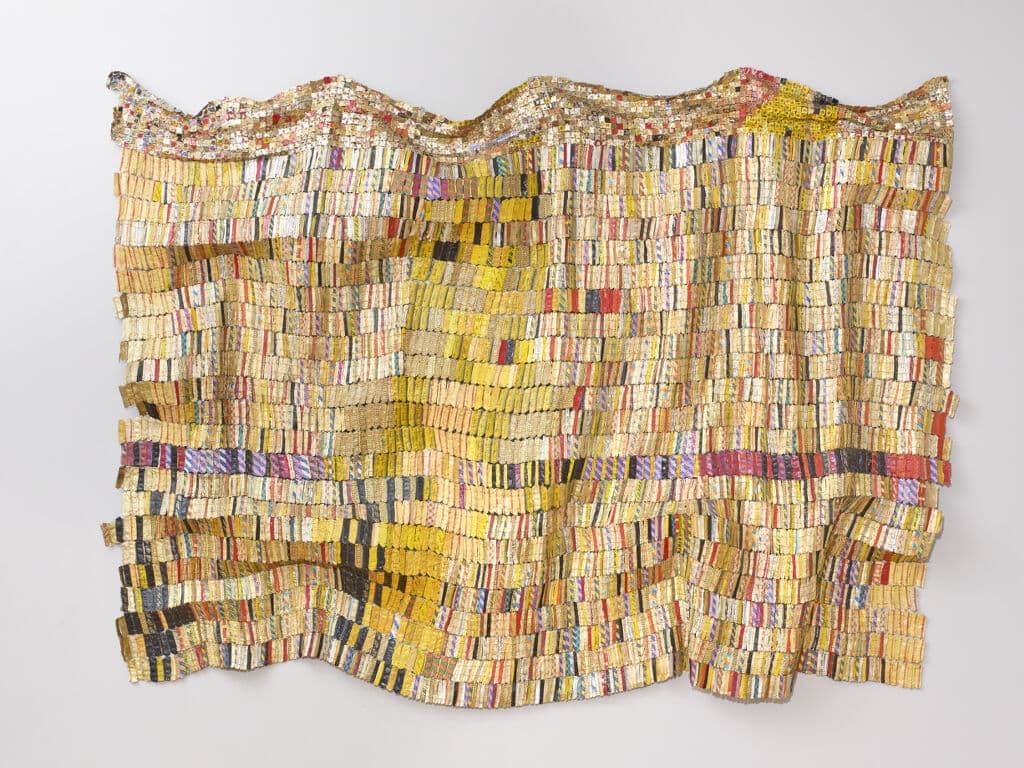
El Anatsui, Taago, 2006, aluminum and copper wire, © El Anatsui.
ESL: What were you envisioning as the visitor experience for this exhibition?
LB: Hopefully to think differently about the material cultural objects, which often get framed as antiquities. The traditions are old, but the objects are actually not old. These traditions are living. They’re making those objects every day now. They’re just traditional objects. They’re craft. And to only present that aspect of making in any place, of course, is incomplete and reductive.
It’s also an opportunity to look at the formalization of colonialism and indirect rule, the tensions with colonialism, especially the latest stages of it, how things were being negotiated. And with the early post-colonial period, how people were making nations in that time, because these are places that didn’t exist before the colonial projects. What do we do at this new place called Nigeria that didn’t exist before? How do we make it our own? How do we manage and govern it and keep these borders? All of these things are expressed through art movements.
1. The Nigerian Civil War (1967-1970), also known as the Biafran War, Nigeria-Biafra War, and Biafra War, was a brutal conflict that began when the southeastern region of Nigeria seceded as the Republic of Biafra.
Share
Related