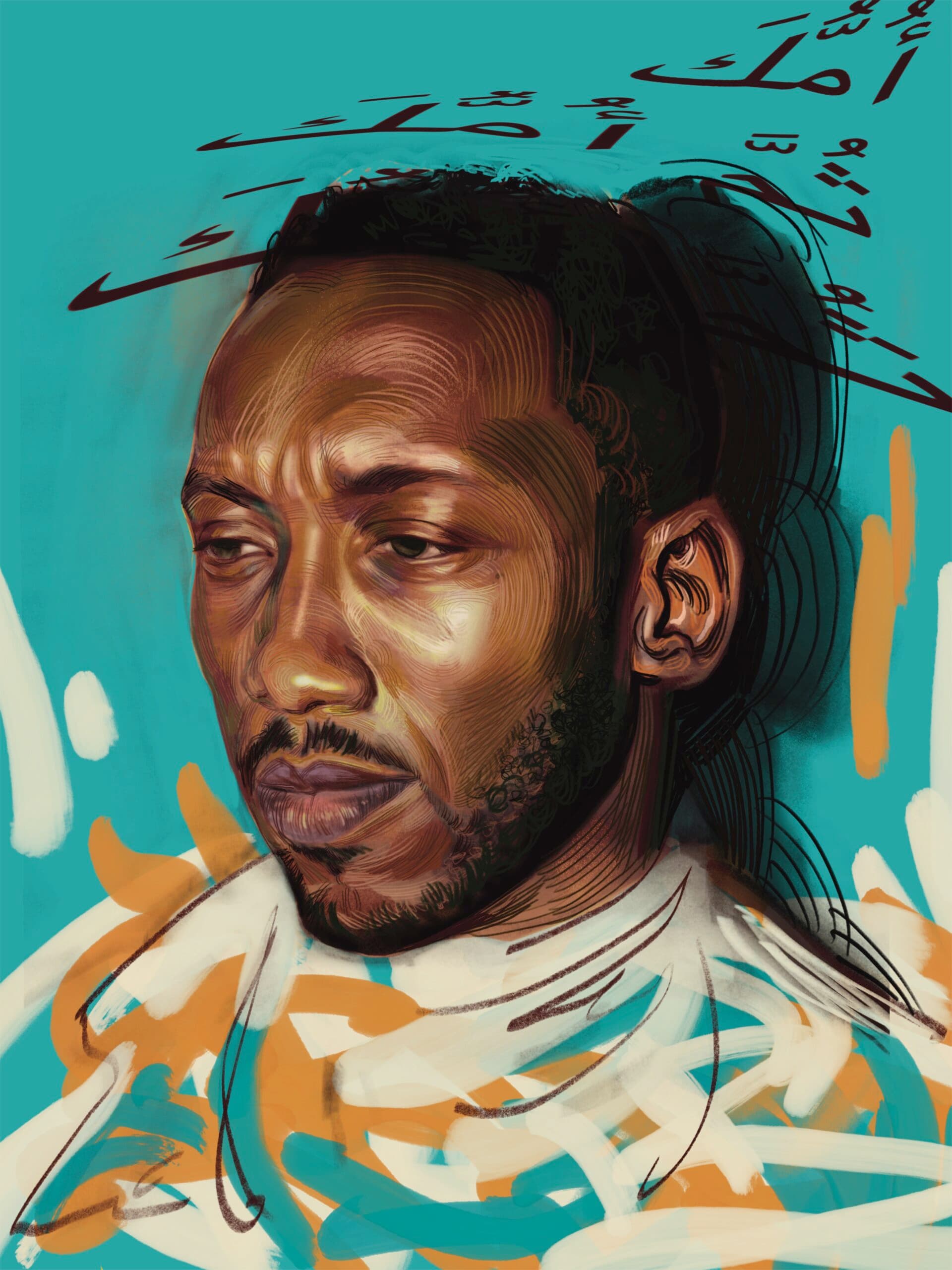
Illustration by Alvaro Escobar Fuentes.
(Profiles)
Mahershala Ali Wants You to Know It’s All Good
Issue 011
OCTOBER 21, 2026
By my count, it’s about seven seconds before he takes the lead by breaking the silence between us.
Dressed in an unzipped green bomber jacket over a cream-colored knitted short-sleeve shirt, with wide-legged beige pants, white athletic socks, and a pair of black slip-ons, Mahershala Ali stares back from across the long white table in a white nondescript conference room in MGM’s downtown Manhattan office. He removes the black reflective sunglasses that cover his eyes as the Big Apple sunlight slowly recedes. The shades coming off give the briefest moment to take in the total Ali effect: the lean, playful-yet-serious face, the relaxed muscular frame, and the mellow Aquarian-ism vibe that’s engaging, complex, and a tiny bit aloof.
Ali moves with ease even when he’s sitting; his presence is calm and thoughtful. He brims with the energy of a star, and I’m struck by his gaze—a certain dreamy faraway-ness that gives the impression of looking through layers, seeing the fuller picture of things. This makes sense. Raised in the Bay Area, Ali initially thought he was destined to be a college basketball star when he was recruited by Santa Clara and St. Mary’s College. Santa Clara’s coach, Dick Davey, sat down with Ali and ticked off his assessment, which Ali recalls as: “You don’t handle the ball well enough, you’re a solid defender, you shoot OK.” Davey made it clear to Ali that he wouldn’t play freshman year, but they would work with him to get his game up to par.
Both parties moved on. Santa Clara recruited a young Canadian hotshot named Steve Nash, while Ali went on to play at St. Mary’s College. He laughs, “I guarded [Nash] for four years; he kicked my ass for four years.” Ali says of his talk with Coach Davey: “It offended me. I wanted a different type of coaching. But when I look back, I see the lesson that I’ve carried through my life: It was what I needed to hear as opposed to what I wanted to hear. If I went to Santa Clara, I would have been that better version of a basketball player, the version I wanted to be. That wasn’t written for me, but I’m very grateful for that experience now.”
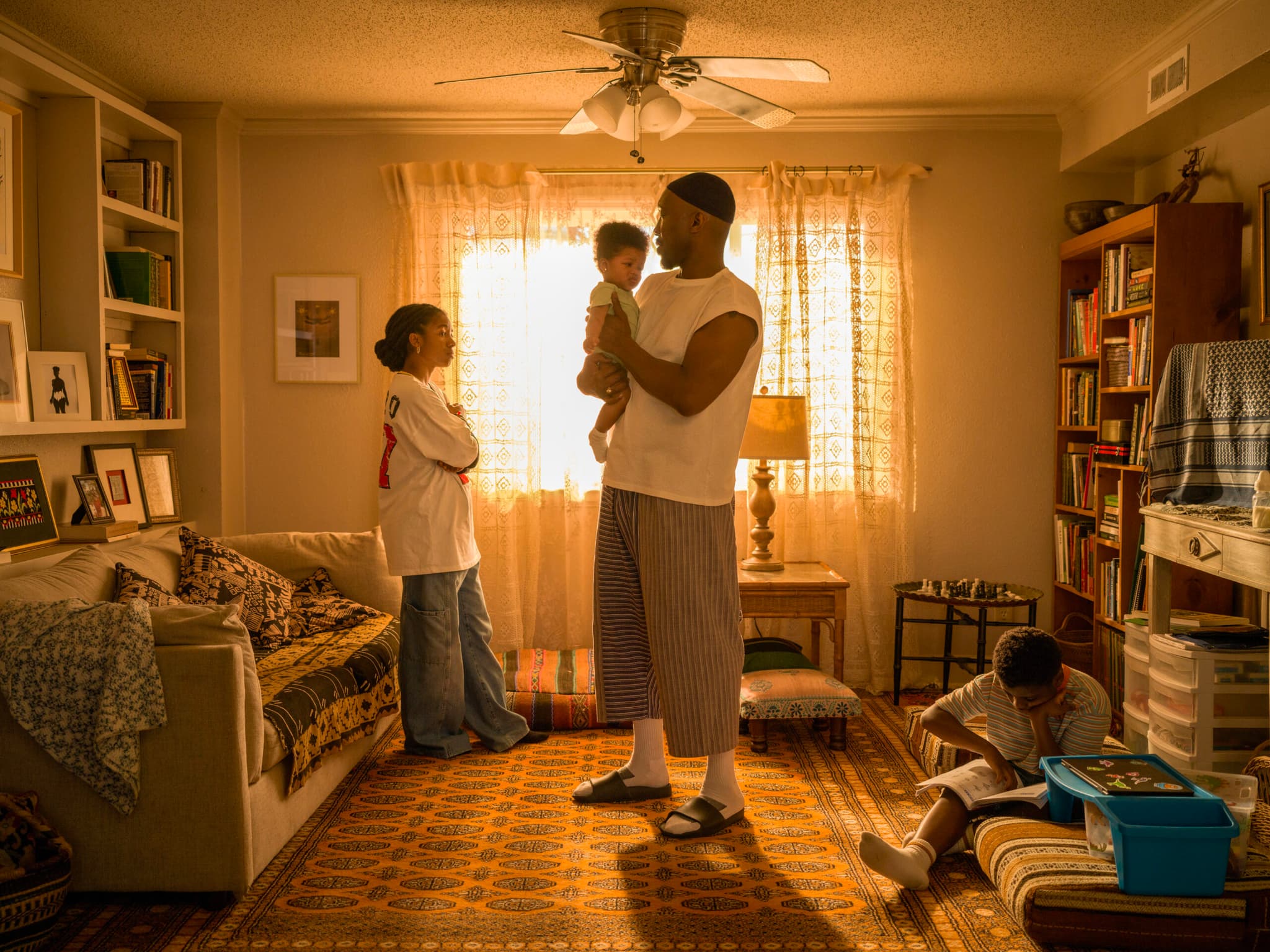
From Your Mother Your Mother Your Mother (2026), dir. Bassam Tariq, photo by Jaclyn Martinez, courtesy Amazon MGM Studios.
Ali’s been acting since the early 2000s, but it feels like he’s still not gotten his due. Add to this Ali’s disposition in the industry: He is an “actor’s actor” who seems to prioritize craft over commercial and performance over paparazzi. He’s got decades of work now—with roles ranging from episodic one-offs to regular roles on various series to his second Best Supporting Actor Oscar win as Dr. Donald Shirley in Green Book (2018)—but for a long time he was recognizable without being quite nameable. The New York Times titled its 2016 profile of Ali “You’ve Surely Seen His Face,” a nod to the notion that Ali was ubiquitous yet somehow overlooked. Those of us who love Ali’s work are quick to remind folks how often we saw him before 2016’s Moonlight: his first TV role in 2001 on Crossing Jordan (2001–2007), followed by Threat Matrix (2003–2004), The 4400 (2004–2007), and House of Cards (2013–2018), along with films like The Curious Case of Benjamin Button (2008), the crime drama The Place Beyond the Pines (2012), and a stretch of blockbuster franchise projects such as Predators (1987–) and the Hunger Games (2012–) movies. But we can agree Moonlight was his star-making turn; everyone knew his name when he won the Oscar that year for Best Supporting Actor.
As Juan in Moonlight, Ali showcased charm, bemusement, and a tenderness that made the character engaging and intriguing. The scene still etched in most of our minds is of Juan cradling a young Chiron as he teaches him to swim. On the shores of a Miami beach, Juan speaks to Chiron in a manner that could have come straight from Ali’s own heart: “At some point, you gotta decide for yourself who you’re going to be. Can’t let nobody make that decision for you.”
Shows like The Wire (2002–2008) might have opened the door to humanizing the layered and intimate lives of Black people in America’s toughest cities, but Moonlight’s small kingdom of Miami characters, where Juan was one of several Liberty City drug dealers, reigned supreme in its multifaceted portrayals. His presence in the film is fleeting—Juan appears for less than 21 minutes of the nearly two-hour film—and his death, mentioned later, is abrupt and unexplained. His portrayal of Juan—as a protector, mentor, father figure, and friend to Chiron, and most importantly, someone with the ability to see the humanity of this lonely young boy struggling to understand his sexuality and place in the world—proves to be one of the most powerful throughlines in a movie full of stellar performances.
Ali’s role in Moonlight elevated his work that preceded and followed it: his turn as the charismatically villainous music and community devotee Cottonmouth in Luke Cage (2016–2018); the unscrupulous lobbyist Remy, searching for a happy ending in four seasons of House of Cards; and Wayne Hays, a by-the-book detective saddled with a broken memory and a deep PTSD-based paranoia in True Detective season 3 (2019).
When he landed a definitive leading role, it came by way of the 2021 sci-fi drama Swan Song, in which Ali plays a terminally ill man who decides to clone himself to spare his family from grief. He delivers an underappreciated, underrated performance in a film he produced (also a first). The film presented the actor with the unique challenge of playing both leads: Cameron and his clone, Jack. Swan Song illustrated Ali’s trademark ability to weave tenderness with conflicting emotions, in a character facing death and the knowledge that he will be replaced by a version of himself when he passes. Most audiences likely missed this lockdown-era movie. It’s a role so delicately performed it’s easy to forget that Swan Song also features Glenn Close, Awkwafina, and a reunion with his Moonlight co-star Naomi Harris. Post-Swan Song, Ali returned to a familiar position as an ensemble member in smaller and big-budget releases, such as Leave the World Behind (2023) and the most recent of the conveyor-belt Jurassic Park franchise releases, Jurassic World Rebirth (2025).
But something was still eluding Ali’s resume: He’d never led in an action film, a genre that he’s long admired. And not just any action star, he wanted to come across as a believable, fallible hero, one you might run into in the real world. A person whose attainable and relatable body looked more everyman than Superman. He shares that Harrison Ford is the everyman he always enjoyed watching in The Fugitive (1993) and his many other action movies: “You felt he was going to win, because that’s how stories go. But along the way, he takes you on a journey where you’re not sure he will. He does a wonderful job of letting [the audience] know that he’s not sure too.”

From Your Mother Your Mother Your Mother (2026), dir. Bassam Tariq, photo by Jaclyn Martinez, courtesy Amazon MGM Studios.
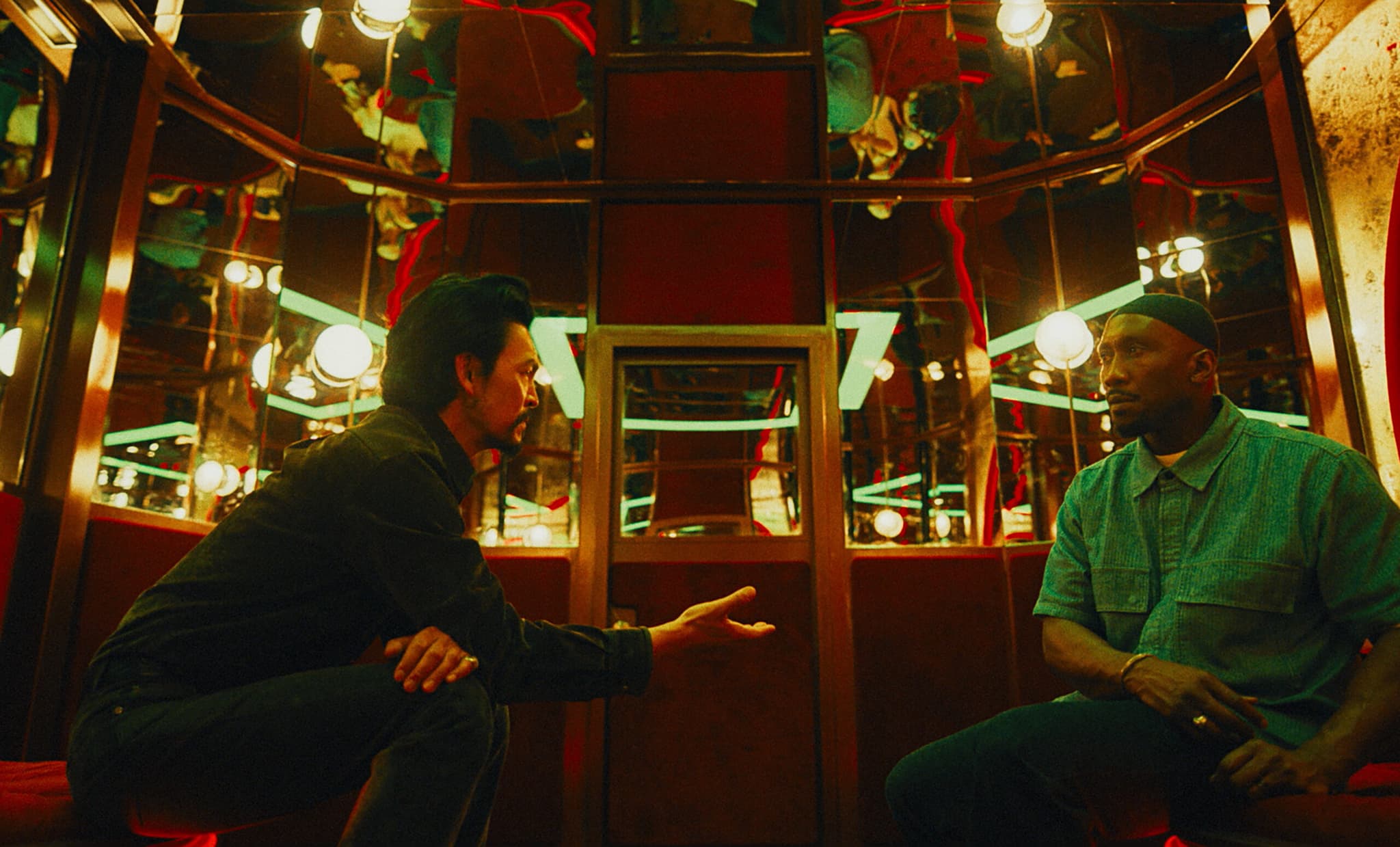
His role in the new film Your Mother Your Mother Your Mother (2026) was this opportunity. Ali plays Latif, a recently widowed Muslim hitman left to raise his three kids on his own. With an unexplained lumbering gait, Latif limps like there’s a line of bodies leashed to his leg. Even in his action scenes, whether in a converted strip club VIP room filled with funhouse-like mirrors or a cramped Houston project-based housing unit, Latif’s body teeters between exhaustion and determination. He’s somehow simultaneously graceful and plodding, and because of the latter, Ali’s approach to Latif heightens the feeling that he’s just slow enough to be beaten sometimes.
For nearly two hours, Your Mother Your Mother Your Mother features scenes where Ali’s body gets pushed, prodded, punched, and pursued. It’s an endurance test of a film, not just for the audience’s temperament for violence, but also for Latif’s body and spirit. Unlike in most popular entries in the action genre, we feel Latif’s accumulation of injuries, setbacks, and mistakes. He’s sometimes out of breath after running short distances, can barely keep his two oldest kids off the internet, and, like many of us, seems to be barely figuring out how to hold it together.
Ali says of his approach to Latif and of heroes he’s drawn to: “They’re going to carry vulnerability, and you’re going to see them on the fringe of breaking. That plays against our societal and cultural understandings and perceptions of men and what they’re good at. You have to show the world your flaws, your Achilles, your soft spots.” He emphasizes the importance of showing this despite how many men want to pretend they’re the emotionless heroes wanting to “move through the world fearlessly and just whip everybody’s ass.” He continues: “The reality is that we hurt, and our feelings get hurt when sensitivities are not honored or recognized. There are opportunities to present a truth around masculinity in different characters, especially when it comes to how men relate to their children. There are opportunities to get more specific about how men love, how men feel, and how men hurt. And even how we thrive.”
When I ask Ali about playing a Muslim character on-screen for the second time, he shares, “I haven’t set out to proselytize through my acting work, but the two times it was relevant to the story—in Ramy (2019–2022) and now Your Mother Your Mother Your Mother—were both pleasant surprises. I want to be conscious and respectful of any faith, but especially my faith. I want to be careful to stay away from [playing] the Muslim guy who’s a terrorist. I just can’t do that.” As Sheikh Ali Malik in Ramy, he says, “I loved the first season of the show. It was something I’d never seen before, witnessing this character have real, honest struggles here in America. I was really nervous about the responsibility of playing an imam.” When the opportunity to play Latif came about five years later, he says, “There’s no way I could turn that down. I felt like [director and writer Bassam Tariq] wrote it for me.”
From Your Mother Your Mother Your Mother (2026), dir. Bassam Tariq, courtesy Amazon MGM Studios.
Your Mother Your Mother Your Mother was a pivot for Tariq and Ali. In 2019, Marvel Studios announced that Ali would rejuvenate and reimagine the half-vampire, half-human horror hero Blade, with Tariq coming on as director in 2021. Blade was last seen in the franchise of the same name popularized by Wesley Snipes in a trilogy that ran from 1998 to 2004. Ali spent a year preparing for the role, doing a mixture of sword work and martial arts, and then the project fell apart. While the exact reasons have never been made clear, in a recent Variety interview, Marvel Studios president Kevin Feige said he felt like a “gigantic loser” for not getting the highly anticipated reboot “off the ground” after a series of plot redirections and script rewrites resulted in nothing. Ali stayed ready and waiting until it became clear it was time for his own pivot.
Tariq still wanted to work with Ali and gave him the script for Your Mother Your Mother Your Mother. Ali read it and knew he had to play Latif. “I got to do so many of the elements that I wanted to do in [Blade],” he says. “I got to wake back up the training from a year of martial arts. We didn’t have the time to train, so [Blade] kind of paid for my training. But this [film] has the emotional weight and responsibility of my more difficult projects and the physical element. I’ve never had a chance as a former athlete to merge those worlds as a storyteller. I mean, Tom Cruise has been sprinting and punching for 40 years. I ain’t done it once.”
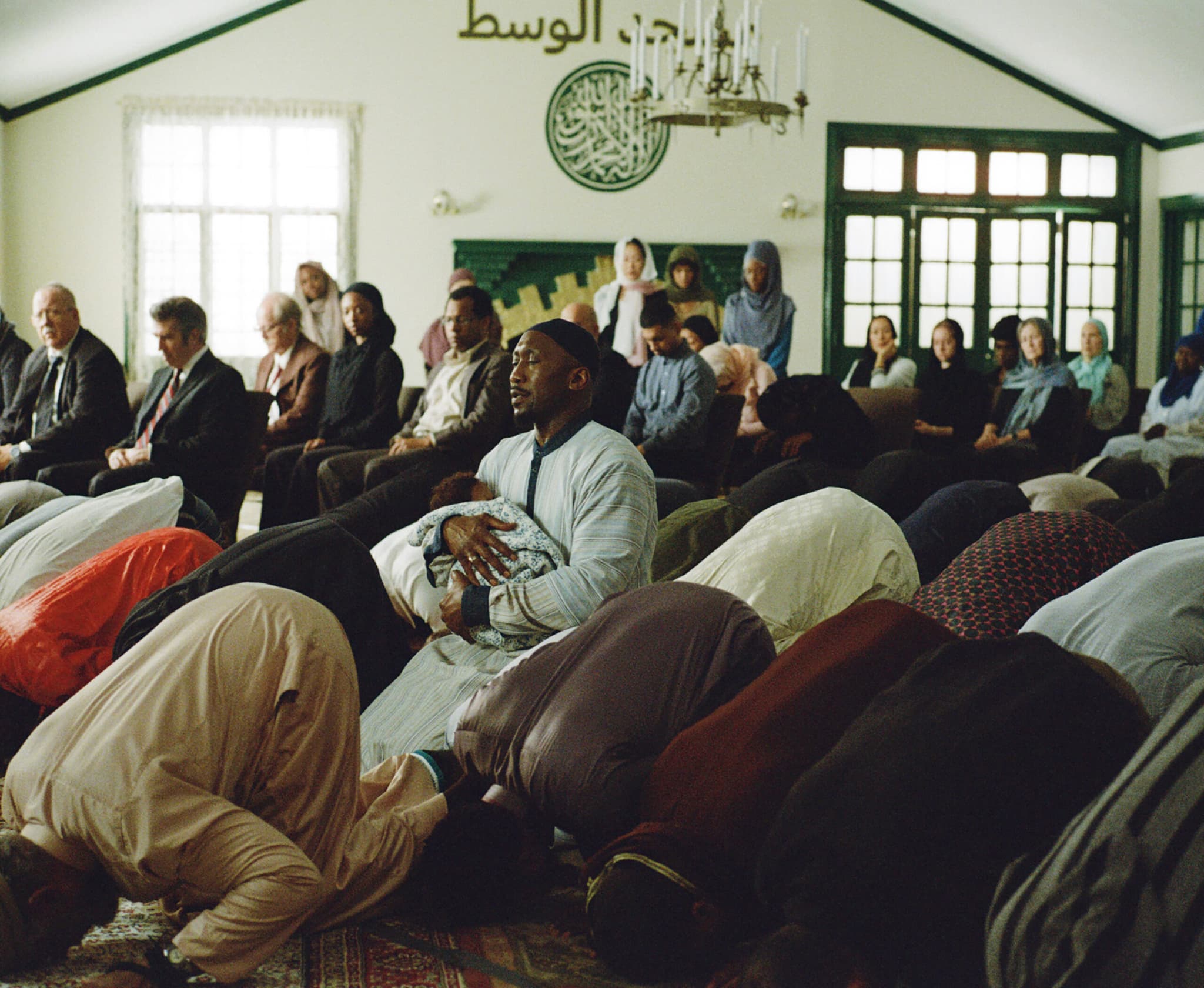
As Latif, Ali has to defeat John Cho’s Christian militia leader, Pastor Hwan Yoon, who is leading a crusade to topple a rumored sex trafficking business. A Muslim American adult film mogul runs this empire, portrayed by relative newcomer Abubakr Ali. Square in the middle is Latif, whose own moral compass is a complex alchemy of faith, fatherhood, and ferocity. But in a unique twist on the action-star leading-man story, Latif isn’t a lone wolf, and it takes a village to provide for his children. We see scenes of Latif and his brood scouring H-town’s Muslim community and the family’s neglected housing complex for breast milk to feed his newborn. Ali says that once he and Tariq “found our language and how to communicate and do the dance together, we had an amazing time. With a film this small, it really comes down to the people. It’s either going to work or not work because of the people involved.”
From Your Mother Your Mother Your Mother (2026), dir. Bassam Tariq, photo by Jaclyn Martinez, courtesy Amazon MGM Studios.
To balance the series of themes, characters, and morals, there was a need to understand Latif beyond being a weapon of justice. The film also illuminates the complexity of US multiculturalism and the ills of capitalism, finding nearly every character ensnared in a cultural dynamic that threatens to consume them, while also showing how people maintain their religious faith in a world that threatens to eradicate what makes you, you. Your Mother Your Mother Your Mother offers chances to explore this through several complicated lenses: inside their housing complex, there are all-male Mormon house meetings, the new local strip club is a repurposed market building, and Pastor Hwan uses the Bible and the internet to recruit and attack the porn industry while harboring his own questionable methods and contradictions.
When speaking about the specifics of the Muslim community featured in the film, Ali shares, “There is real value in unearthing a story that features folks—a Black Muslim community in Houston, a place that hasn’t gotten its shine—that we haven’t seen, in a city we don’t know enough about. Bassam did a wonderful job of building that world in a way that feels real and lived in.”
As Your Mother Your Mother Your Mother goes out to theaters, Ali’s thoughts on how his career has played out so far mirror his Santa Clara/St. Mary’s College sliding doors moment when he was 17. The opportunities and projects he’s had comfortably sit aside the near misses and the leading-man status delay. This isn’t necessarily a moment of arrival for Ali so much as the steady march of being respected for what he brings to every project. Not everything’s meant for you, and some missed opportunities are just affirmations of where you’re supposed to be headed. His face beams thinking of Latif in Your Mother Your Mother Your Mother: “I’m very happy to finally be in my natural element, even if I’m super grown doing it, you know? It comes to you when it comes to you.”
Share
Related