From Life on the CAPS (2022), dir. Meriem Bennani, courtesy of the artist.
(Profiles)
How to Look at Our Collapsing World without Going Numb
Issue 010
MAY 20, 2026
Even when it takes absurd and hilarious shapes, Meriem Bennani’s work—part animation, documentary, Chaabi memes, and speculative and sci-fi world-building—does not offer refuge from this world; it insists on being in it, rendering perceptible what bell hooks named the “imperialist white supremacist capitalist patriarchy.”
Through these hybrid artistic forms, Bennani makes space where our joy, grief, ghorba (exile and longing for home), political rage, and tenderness can coexist without being flattened into spectacle.
This is a radical imagining Bennani offers us, given that political, social, and ecological collapse is never evenly distributed; we know it is felt most acutely at the intersection of marginalized identities and state violence. Bennani’s universe is not concerned with whether art can save us but whether it can propel us to expand and sustain our political imagination when everything around us is designed to extinguish it.
I was sitting with the weight of these concerns—amid the livestreamed genocide of Palestinians and the annihilation of Gaza—when I returned to her films in the fall of 2025. I write this from the southern shore of the Mediterranean, now fully militarized into Europe’s outsourced border. As I scroll past videos of ICE kidnapping people in broad daylight in the country where Bennani lives, it is impossible to read her work outside this political and affective terrain.
Home is not singular for Bennani. For the past 15 years she has made New York home, revealing a city—within the belly of empire—as a site of chosen family, political becoming, and collective care. Homecoming to Morocco is a throughline in her work: a return that carries grief alongside joy and refuses nostalgia.
Bennani affirms the idea that belonging is dynamic, unstable, and effortful, especially across diaspora. During our Zoom conversation¹, speaking in French, our shared colonial language, she reflects: “Belonging is not just about a country but people. It’s a mode of being. And it has to stay alive, not sentimental.” Distance, she notes, is not a rupture but a condition: “I realized I was becoming diaspora when distance itself became part of the relationship.” In this context, ghorba is not loss but practice.
With Bouchra (2025), a CGI-animated feature written and directed with Orian Barki, these questions come fully into view. The film carries autobiographical traces but defies every category it might be expected to inhabit. It is not a coming-out narrative but a fictionalized self-portrait of queer longing and belonging across geographies, without requiring resolution. Bennani lends her voice to a rascal navigating an anthropomorphic yet hyperrealistic universe, whose uncanniness introduces distance without abstraction. Bennani explains that the film emerged from what she and Barki could not write, and that a conversation with Bennani’s mother—initially recorded for research—unexpectedly became the spine of the film.
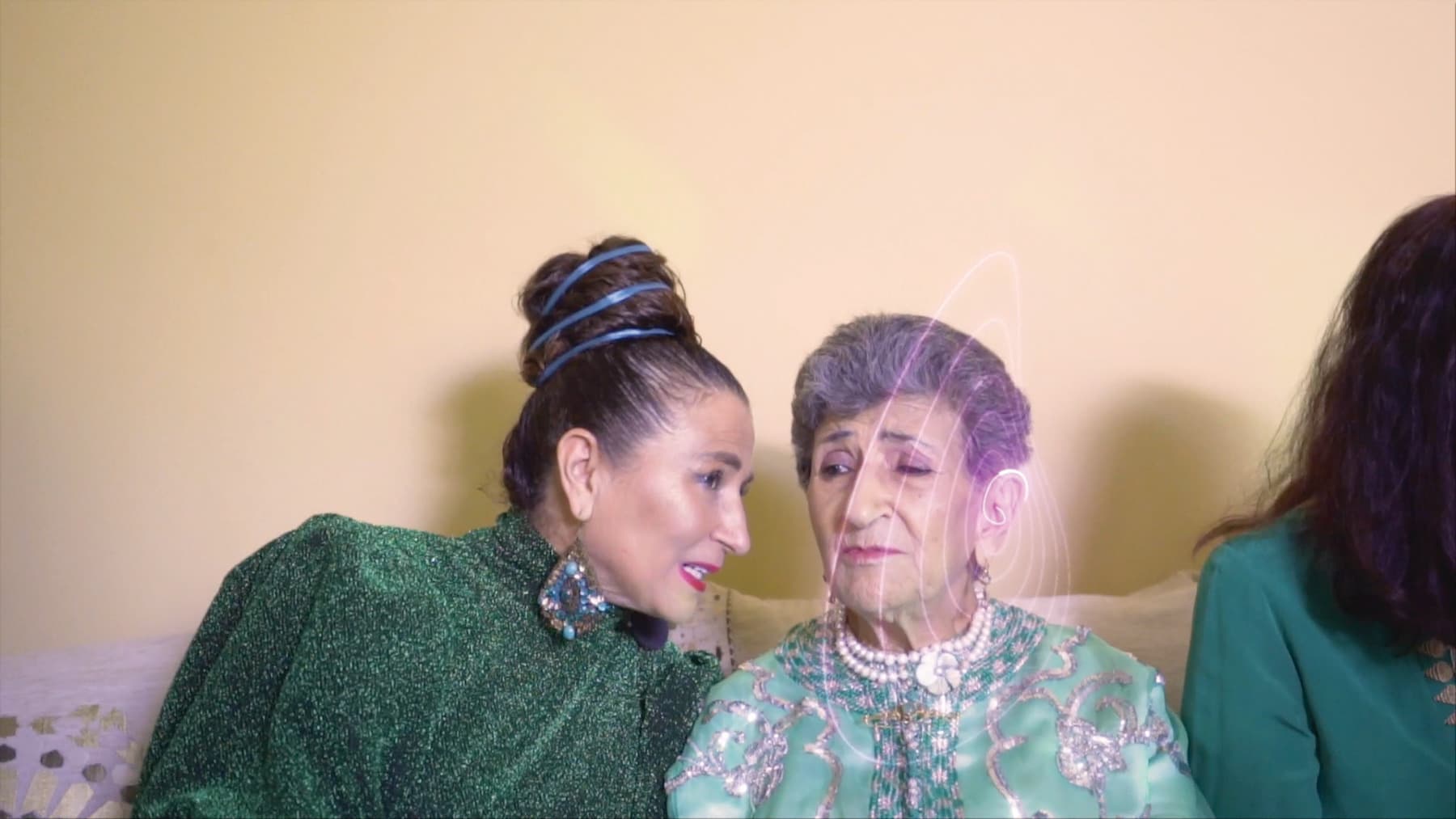
From Party on the CAPS (2018-2019), dir. Meriem Bennani, courtesy of the artist; François Ghebaly, Lodovico Corsini; and Sadie Coles HQ.
The women in Bennani’s family have always been central to her practice. They are inspirations, protagonists, co-creators, her North Stars; not as material to be shaped, but as presences that actively shape the work. Lineage here is not content but method—relational rather than representational, never ethnographic, never extractive. What is foregrounded is not proximity but how relation is sustained across distance, time, and asymmetry.
In Bouchra, this method sharpens into what Bennani refers to as a process of daughtering. This labor of learning how to be in relation with a parent anew as an adult is a constant negotiation. This is complicated in Bouchra by constructing a fictional version of her mother as a protagonist (voiced by artist Yto Barrada). Through this friction, daughtering and queerness take shape together, carried by conversation, humor, care, hesitation, and the silences the film chooses to protect. Intimacy is felt yet never voyeuristic or didactic.
This refusal of closure and an insistence on relation as something practiced rather than possessed situate Bouchra in kinship with Valentin Noujaïm’s Oceania (2024). Both resist the expectation that queer Arab lives must appear as coherent narratives or legible claims. Instead, they dwell in the quotidian, holding community and isolation, shame and care, ghorba and belonging all at once. Free from the demand to explain themselves to a dominant white gaze, these films invite complexity. Opacity and contradiction are not obstacles here but conditions of possibility.
For the global majority, the migrants and the colonized, violence is a baseline. In Bennani’s work, the representation of this violence and oppression is never apolitical, as it exposes the machinery that produces it. The logic is made absurd, visible, and unmissable. She makes systems of domination legible without succumbing to the fantasy that we are powerless within them. This clarity sets Bennani apart from much of the work circulating under the banner of Arabofuturism and diaspora art.
Unlike Afrofuturism—which has decades-long genealogies linked to Black radical thought, community organizing, and speculative fiction, with Octavia Butler as a foundational figure—Arabofuturism has largely taken shape within contemporary art circuits, where futurity circulates more as aesthetic than political praxis. This tendency was evident in the 2024 Arabofuturs exhibition at the Institut du Monde Arabe in Paris. With some exceptions, most notably Bennani’s Party on the CAPS (2018–2019)², futurity mainly appeared as colorful mood boards—world-building reduced to branding and surface, echoing what Zarina Muhammad calls representation without criticality³. In these spaces, visibility functions as a commodity: identity is the ticket to access the hegemonic Global North and Gulf state arts funding and spaces.
Bennani does not simplify her art into an identity product to seduce the white gaze; her work rejects this bargain for visibility. In her practice, futurity and identity are material, social, and political, not an aesthetic veneer that disavows the violence that shapes it.
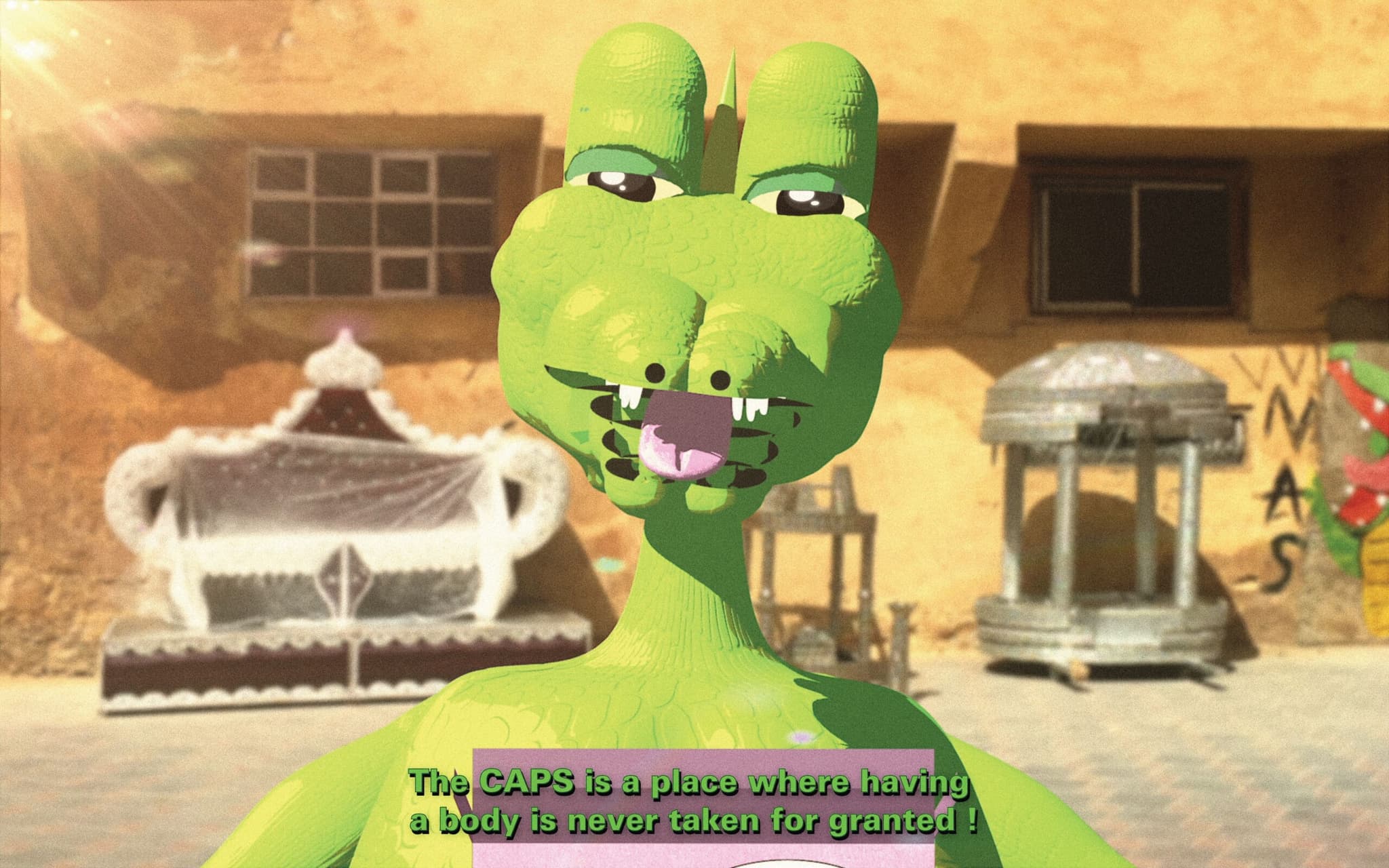
From Party on the CAPS (2018-2019), dir. Meriem Bennani, courtesy of the artist; François Ghebaly, Lodovico Corsini; and Sadie Coles HQ.
The eight-episode animated series 2 Lizards (2020), co-created with Barki, was released during the first lockdown. Calling this “COVID art” would flatten it since 2 Lizards didn’t simply record a moment; it exposed the systems of racialized and capitalist violence for those willing to see and contribute to upending them. This clarity is echoed powerfully in episode 7 of 2 Lizards when a journalist ignores a literal pig cop and instead gives airtime to those flooding the streets of New York to protest the murder of George Floyd. Black voices laced with humor call out the white liberal performance of racial reckoning, and then the lizard voiced by Bennani acknowledges that non-Black people of color must also confront anti-Blackness; the other, voiced by Barki, holds a poster to advocate for Black trans people’s lives. Recognition of our own implication in harmful systems is a first condition of refusal; without it, the foundations of coalition and solidarity remain hollow.
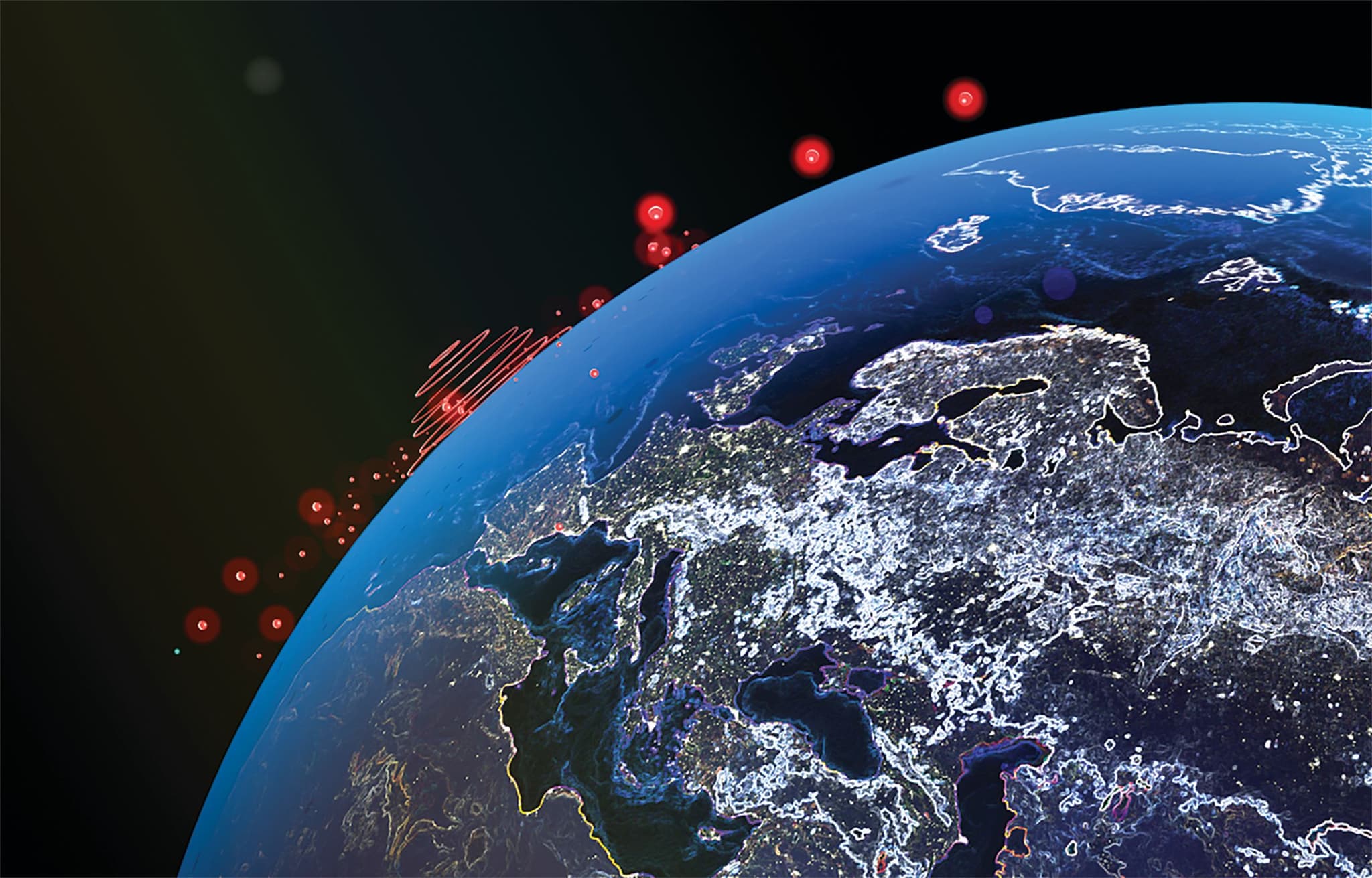
Held together, 2 Lizards and Life on the CAPS trilogy (2018–2022) make one thing unmistakable: dystopia is not the future; it is our present. In Bennani’s trilogy, the futuristic migrant detention island run by the US in the middle of the Atlantic named CAPS, is absurd only because it is so plausible. Bennani introduces only one speculative element, teleportation, into the all-too-real cruel border regime.
When Bennani began Life on the CAPS in 2018, ICE raids and executive orders for multiple “Muslim bans” were often framed as excesses of a single administration. Rather, the ideology behind this violence belonged to a much longer imperial and racialized border regime that has preceded and outlasts any one presidency or political party. The liberal relief narrative that followed the Biden presidential win recast border and carceral violence as aberrations rather than a structure, allowing the conditions the trilogy exposes to persist and intensify. The violence many associate with the border is not located at the perimeter of the US state; it is everywhere inside it. Police militarization and surveillance technologies are perfected on racialized communities4; there is no safety within stolen land.
If Life on CAPS looks outward at the infrastructures of domination, the exhibition Sole Crushing (2025) turns inward to examine what domination feels like—not metaphorically, but somatically. In a massive multi- and open-floor installation, over 200 suspended flip-flops, activated by a visible pneumatic system, slap their pedestals in rhythmic unison, driven by a sound score co-created with Cheb Runner (Reda Senhaji). “I’m really interested in what domination feels like in the body—not as an idea, but as exhaustion, rhythm, breath,” Bennani shares during our conversation.
The sound, playful in its excess and hypnotic in its repetition, all stamina and propulsion, carries the energy of football stadiums, protest chants, or the trance of the Dakka Marrakchia. Until it doesn’t. The rhythm becomes labor, and the breath progressively burns out. The space becomes a stage where compliance and exhaustion merge into a choreography of alienation. Sole Crushing reveals the emotional weather and exhaustion of trying to stay connected, organized, and alive inside a system designed to grind us down, individually and collectively5.
In a time when Big Tech and fascism increasingly work in tandem, Bennani observes: “The technology that surrounds us is designed to look friendly, to appear harmless. But that is precisely how it becomes dangerous. Science fiction allows me to speculate from what is already very real.” In the past five years, Bennani’s work has stood out—distinct from other artists working in sci-fi and from diasporic positions—because she stays away from nihilistic despair, self-exotification, and the comforts of numbing escapism. It is precisely through this refusal that her artistic evolution comes to mirror our political exhaustion while still insisting on the necessity of imagining otherwise and of acting.
A clear belief runs across her work: nothing about the present is inevitable. Borders and domination are systems, not fate. Institutions are constructs, not eternal. Oppression is maintained, not natural. Imagination is not escape; imagination is the practice that keeps us capable of collective transformation.
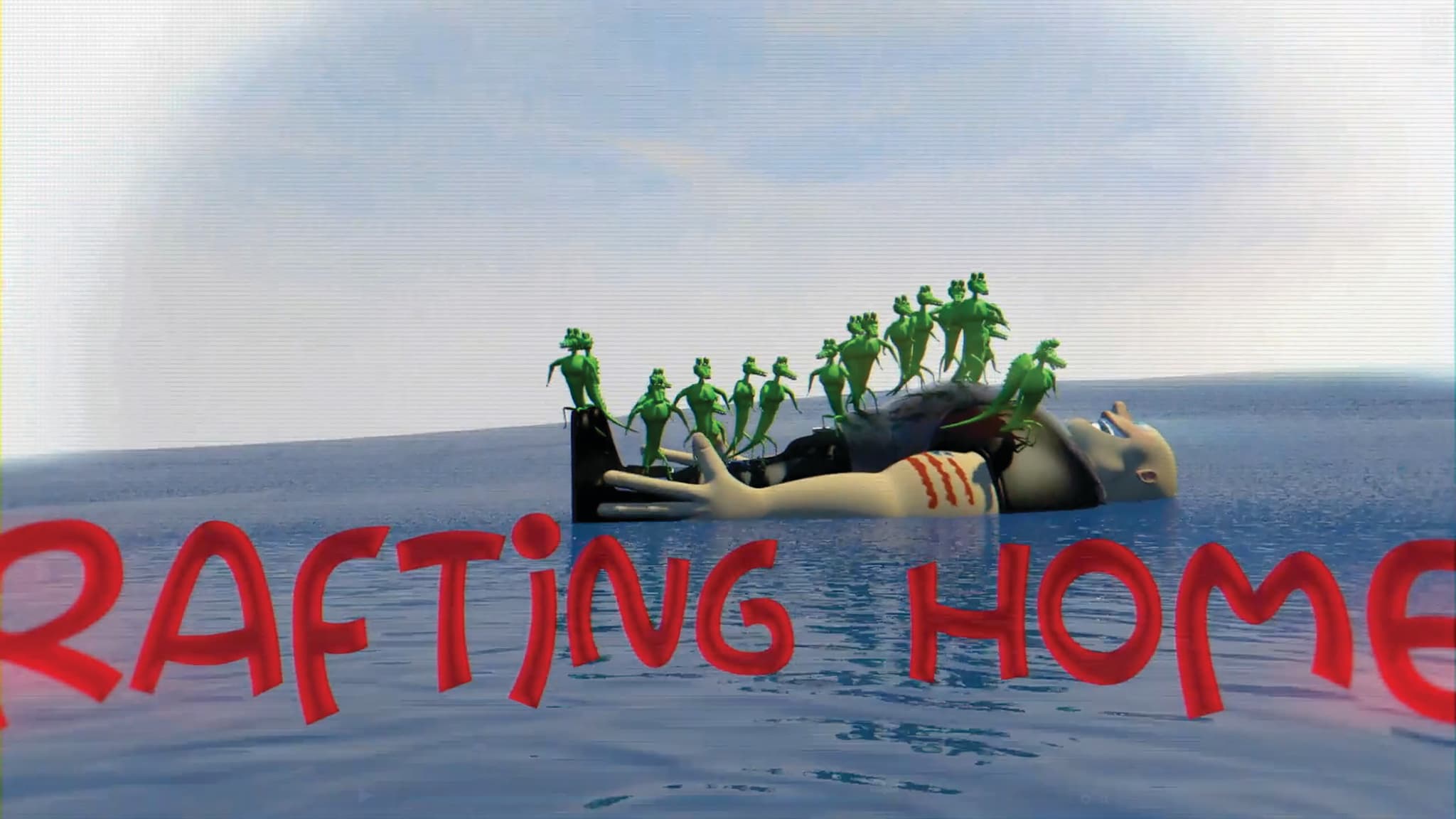
From Party on the CAPS (2018-2019), dir. Meriem Bennani, courtesy of the artist; François Ghebaly, Lodovico Corsini; and Sadie Coles HQ.
- This conversation took place in November 2025 and is translated from French by the author.
- The first film from the Life on the CAPS (2018–2022) trilogy.
- In her two-part essay “The Problem with Diaspora Art” that centers South Asian diaspora art: https://thewhitepube.co.uk/texts/2023/the-problem-with-diaspora-art-2/.
- Since 2014, the Black Lives Matter movement brought abolitionist demands into the mainstream and exposed globally the entanglement between US policing and the Israeli military.
- Sole Crushing echoes how Noujaïm stages the futurity of class, queerness, and surveillance in To Exist under Permanent Suspicion (2024), rendering structural violence as a felt experience. Viewed together, these works make it impossible to return to a state of denial. This film was the second installment of Noujaïm’s La Défense trilogy (2023–2025) and was screened at the 2024 BlackStar Film Festival.
Share
Related