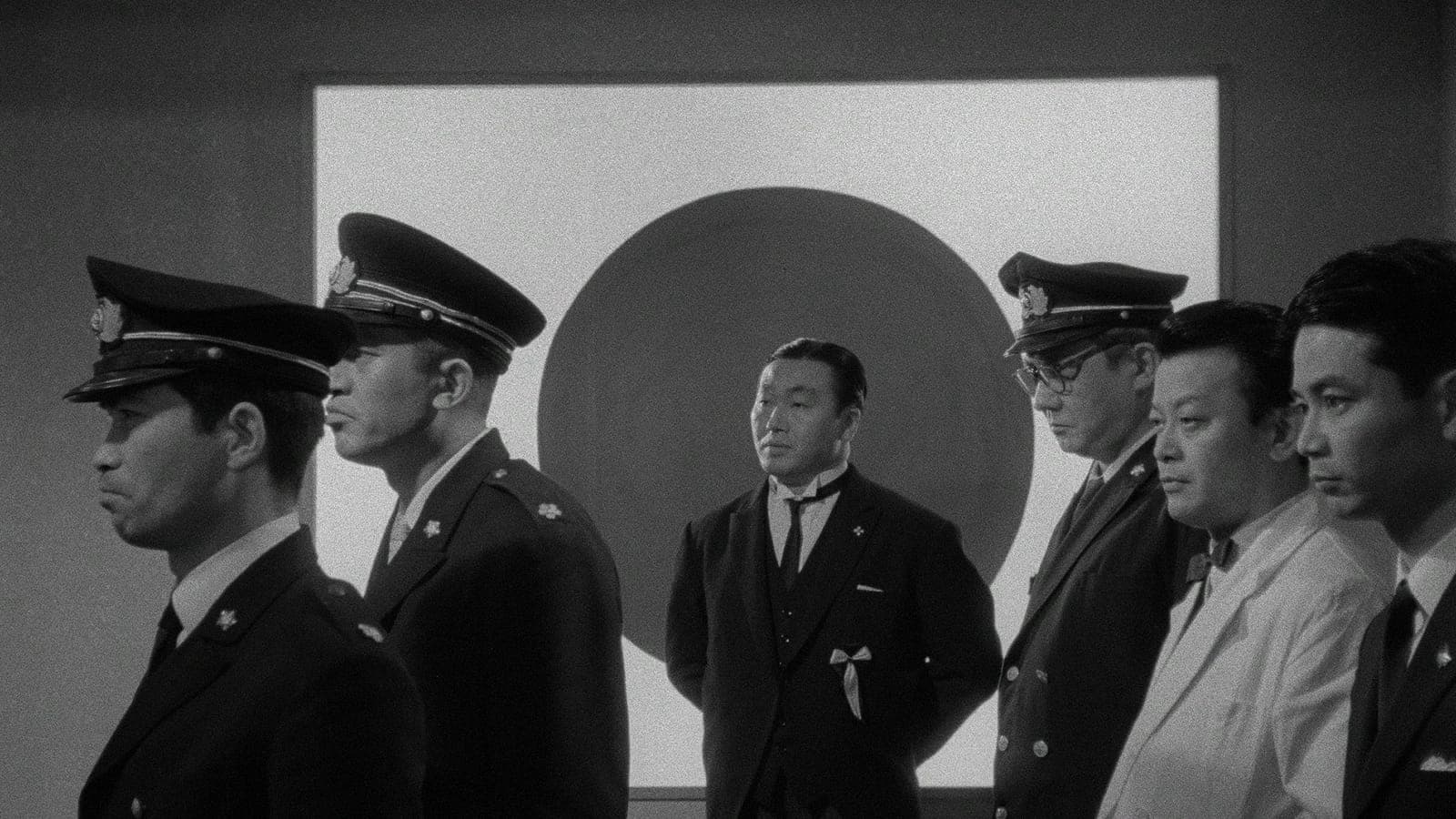
From Death by Hanging (1968), dir Nagisa Ōshima, courtesy The Criterion Channel.
(Reviews)
I Refuse to Be Killed by Something That’s Invisible
Issue 011
OCTOBER 21, 2026
A man on the verge of capital punishment lies unconscious, ignorant of both his alleged crimes and the state seeking to punish him to this highest degree.
The fragility of the nation-state project is laid bare 10 minutes into Death by Hanging, Nagisa Ōshima’s 1968 film set in the wake of the Japanese empire’s violent 35-year colonization of Korea. The slumberous man is R, an ethnic Korean living and facing death in Japan. A nervous chaplain, an indifferent doctor, and various military officers confer with a stone-faced prosecutor and his deferent clerk on whether the state can execute an unconscious man. The clerk softly suggests that R’s condition renders him unable to feel remorse, nullifying the state’s aspiration for righteous violence. His death is a punishment meant to stand the height of his crimes. An obtuse military officer paraphrases the slippery logic: without consciousness, R can’t feel guilt, and without guilt, the state is unable to have the moral cover to “legally” kill him.
This conference is a dioramic representation of nation-states and their polities: a fundamental monopoly on violence, the legal codes that enshrine violence into law, and the surpliced rituals to moralize such violence. Ōshima has constructed the architecture of a state on film as it is in life. And state encounter, though not always as severe as in Death, happens most often through an ever-growing matrix of law and order covering the state’s interests across land and body.
From this impasse of unconsciousness, Death’s plot unfurls out of the confines of the execution chamber and to the sites of R’s alleged crimes in absurd fashion. Ōshima plays humorously around the ambiguities of human consciousness. He prolongs the film’s central standoff: R regains his physical consciousness but has no sense of himself or his past. The state’s various actors respond by reenacting his crimes and staging scenarios to imbue him with an identitarian political consciousness: a Korean, so in their eyes, predisposed to criminality, dysfunction, and vengeful acts of violence against the Japanese. They hope to convince him, as well as themselves, that it’s righteous he should die by hanging. In this process, falling under the influence of alcohol and the stupor of fraternal complicity, members of this cadre confess to crimes not dissimilar from those they accuse R of. But it’s clear they forgive themselves, as does their nation. Ōshima employs comedy most generously here.
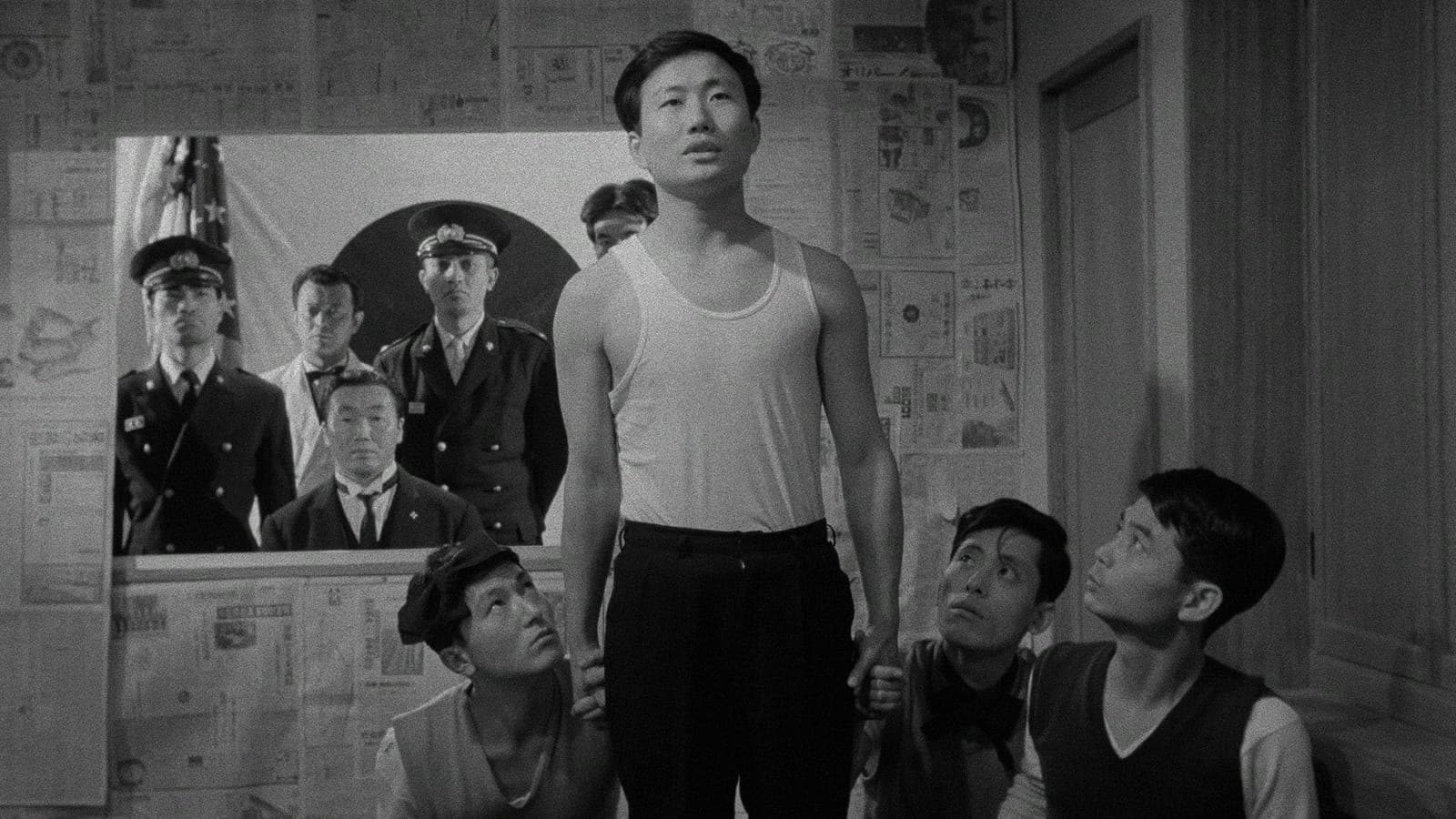
From Death by Hanging (1968), dir Nagisa Ōshima, courtesy The Criterion Channel.
As he slowly comes to discern his alleged offenses, R accuses the state and its executors of the same criminality they seek to punish him for. But the nation-state’s concern with administering justice is concomitant with its monopoly on violence. Any contradiction born out of this situation is to be reconciled by the people—the citizens, the aspirant citizens, and the alleged criminals. State violence is configured as a project of justice. In 1919, German sociologist Max Weber articulated a “state’s monopoly on violence” as its foundational feature. It’s with this posture that states expand their jurisdiction: more land, more people, more resources where they can adjudicate and so perform violence.
The past two decades, by virtue of digital capture and circulation, have given us a barrage of satirical, Brechtian scenes from the theaters of state capitols, international courtrooms, and podiums propping authoritative seals. And from the ground, scenes of gruesome killings and torture arrive daily. Justice, should we anticipate its arrival from up above, is absent, but law, or its obverse, is administered widely by the most violent states. “I want to state emphatically here that violence in any society is neither moral nor is it ethical,” writes Kwame Ture¹ in 1969 in his essay “The Pitfalls of Liberalism,” where he critiques the liberal’s affinity for the state’s promise of law and order. “It is neither right nor is it wrong. It is just simply a question of who has the power to legalize violence.”
In the 1950s and into the 1970s, it was precisely through violent struggle that Africans across the continent resisted against the brutalities of colonialism and achieved independence. The nation-state came to contain their victories. Its polity was the most legible and offered memberships to the United Nations, the World Bank, and the International Monetary Fund, each formed in the mid-1940s. Liberation, as a unifying force, was transmuted into nationalism and a new globalized belonging. Borders of newly formed nation-states traced along mercantile colonial boundaries. And to stand these new nations up, new contracts were drawn. Old colonial industries were baptized as national economies by intergovernmental organizations and the neocolonial world order they maintain.
It’s at this crucial time we encounter El Hadji Abdoukader Beye, the lead of Ousmane Sembène’s Xala (1975). And for the crime of greed, he stands trial in a series of tribunals in newly independent Senegal. Adapted from his novel by the same title, Sembène’s film follows El Hadji, a seasoned businessman and a member of the new nation’s chamber of commerce. “It is the sons of the people who now lead the people on behalf of the people,” a voiceover declares. Besuited French men exit the hallowed halls of the chamber, and replacing them are Senegalese men in waist-length mbubbs, the region’s beloved wide-sleeved kaftan, and pants to match. But the white men soon return with suitcases of cash in CFAs, then standing for Colonies française d’Afrique, and today for Communauté Financière d’Afrique. Perhaps in anticipation of their new and lucrative seats of power, the Senegalese chamber men’s clothes transform into suits and tuxedos.
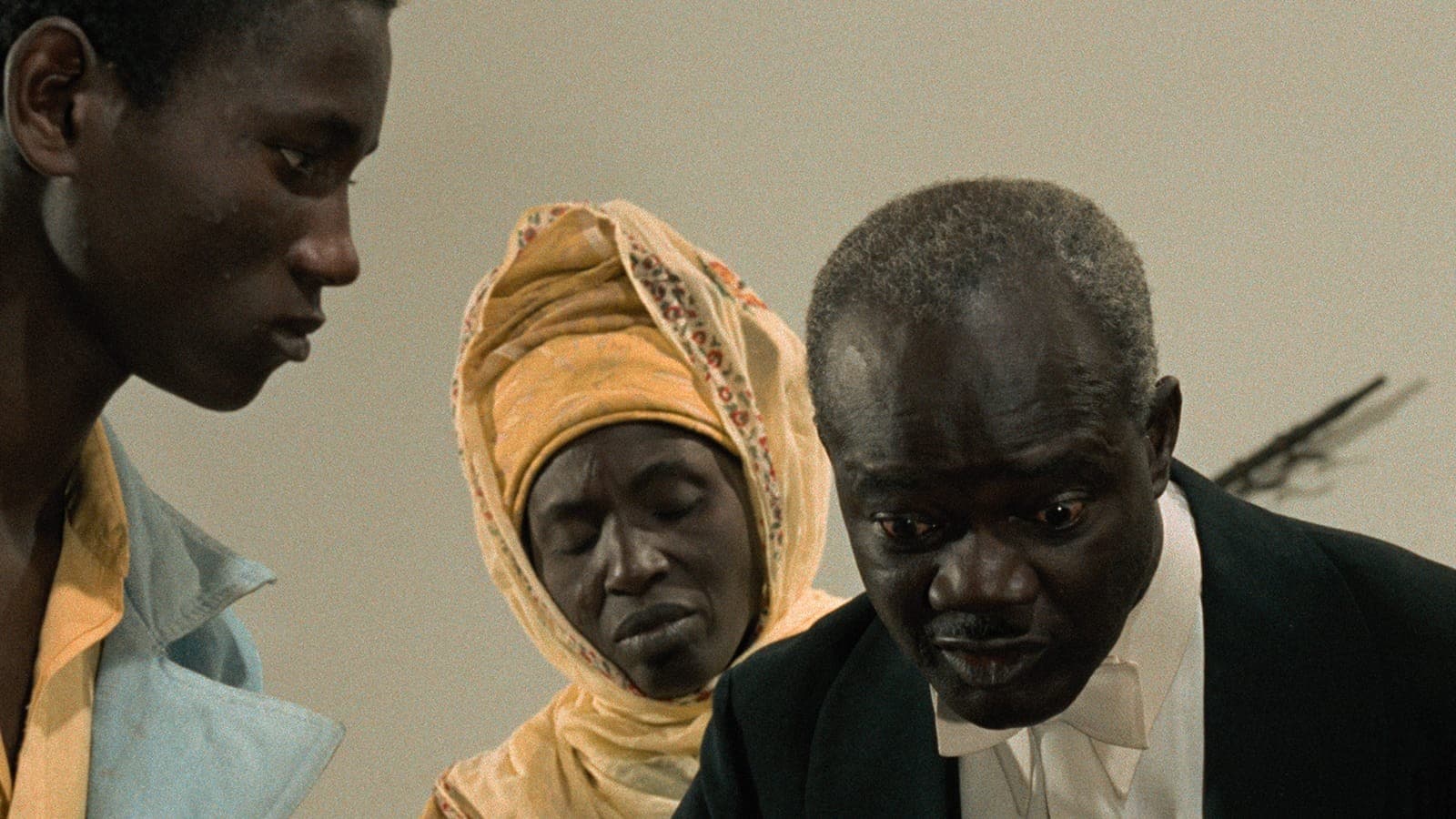
From Xala (1975) dir. Ousmane Sembène, courtesy Janus Films.
Sembène, like Ōshima, employs a bold-faced satire to frame the fallibility of the nation-state. In his story, the nation is led by a comprador governance that extends colonial expropriation and repression, long after the people of the land struggled for independence. “The national bourgeoisie of under-developed countries is not engaged in production, nor in invention, nor building, nor labor,” writes Frantz Fanon in The Wretched of the Earth. “[It] is completely canalized into activities of the intermediary type. Its innermost vocation seems to be to keep in the running and to be part of the racket.”²
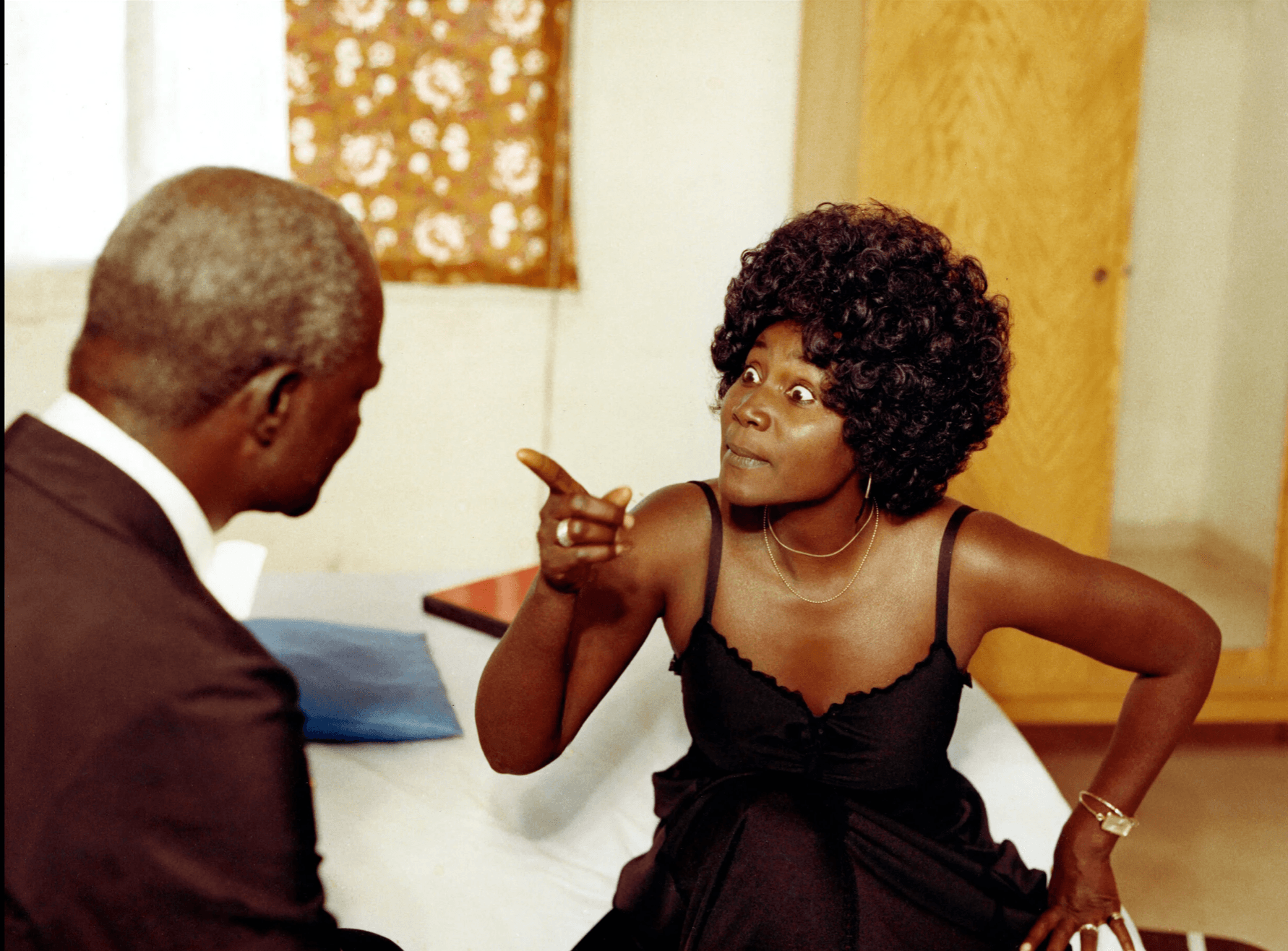
Xala is a caricatural portrait of this greedy bourgeois racket. El Hadji is soon to marry a third wife. His matrimony is financed by the surreptitious sale of bounties of rice embezzled from the country’s farmers. The wedding celebration itself is replete with objects of Francophile bourgeoisie: cigars, champagne, and distasteful conversations about negritude in French.
But El Hadji’s minted ascent is soon met with hurdles. He faces censure from his first daughter, Rama, as well as his second wife, Oumy, about the matter of a third wife. Then, he experiences xala, a temporary curse of impotence preventing him from consummating his precarious new marriage. The bride’s family convene a tribunal in the party’s yard judging his virility and his rejection of indigenous traditions, charges that seem to outweigh the dowry of gold and electronics on a table nearby.
Soon after, the country’s chamber of commerce summons El Hadji. His checks have been bouncing, and whatever happened to the rice from the national grain stocks? He’s brought shame to their shameless theft, they tell him in French. He pleads his case in Wolof, a desperate attempt for indigenous compatriotism. The chamber is unmoved. A member even accuses him of racism and sectarianism. He complies, returning to French, and insists they’re all “crabs in the same basket,” all guilty of bad checks, rice trafficking, and employing the state’s security apparatuses for personal use. They nod and concur but still vote him out. They find his behavior garish and uncivilized. The new nation serves an old master. And El Hadji is not only impotent, but he’s also no longer of this state. He’s one of the people the state faithlessly represents. Citizenship is a devastating blow.
The people, in turn, have their own justice apparatus. Senegal as a new country hasn’t shaken off competing polities and powers pre-dating the nation-state: curses that travel against the currents of power and medicine men who can break and reinstate them. A procession of farmers he embezzled from, along with others he’s wronged, enter El Hadji’s home with ease. From his fridge they drink his French water and eat his French yogurt before stating their case against him. Should he accept their sentence, their justice can deliver him from his curses.
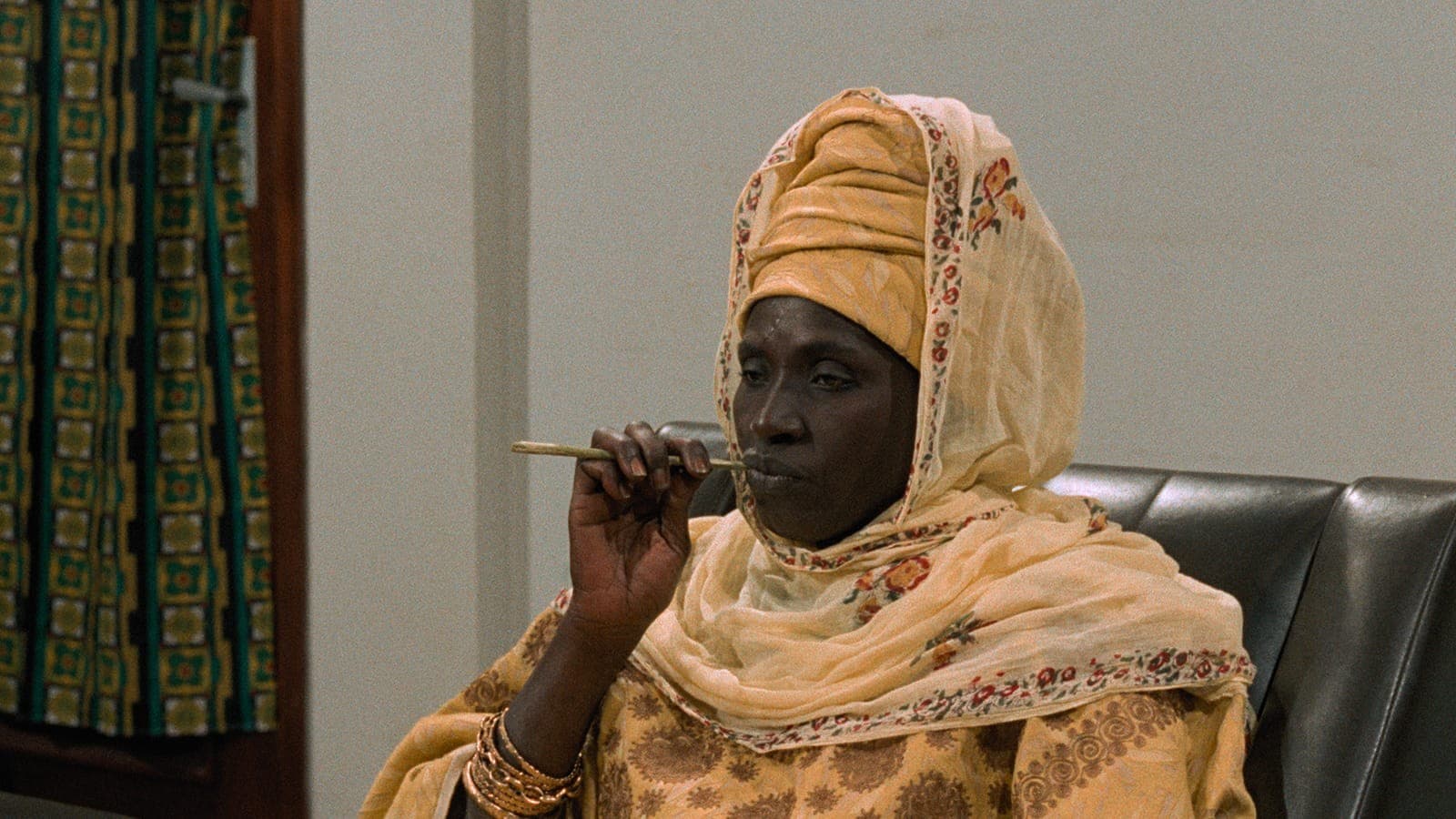
From Xala (1975) dir. Ousmane Sembène, courtesy Janus Films.
“The masses could never seize state power,” proposed the Caribbean situationist Joseph Edwards, “because the state is a hierarchical form of social organization and could only be seized in the name of the masses by somebody else.”³ The men who enter El Hadji’s home prove Edwards’s sentiment just as much as El Hadji himself. In both his nation and R’s, the state rules to maintain its order of power, making righteous the act of thieving and killing, in the name of greater good, in the name of the people.
Where do the people stand vis-á-vis the nation-state today? Its authoritarian leaders seem to have fallen out of favor more than its structure. In the United States, as with other imperial powers, national borders and their violent adjudication tend to swell with capital interest. Recently, the country’s border has been freed from the confines of lines on a map. It roams the streets through law enforcement mechanisms and deputized gazes. Dissent against this violence is met with even more violence. Across land and water, US bombs are deployed from various army bases scattered across the world, with leaders kidnapped or assassinated. Where does this people’s nation-state actually end? National sovereignty is an uneven matter, tilting towards those with the most capacity to “legalize” violence. The inconsistencies pile on and remain the people’s to sort out. Satire is a useful tool to displace the weight of incoherence. As a form, it could plausibly deny a critical intent should its authors face questioning.
In the final act of Death by Hanging, R fully regains consciousness. In fact, he’s reached something like an enlightenment that collapses the rationale of the officers in charge of his death. “We aren’t killing you. The nation simply can’t allow you to live,” one officer says. R responds calmly: “I don’t accept that. What is a nation? Show me one. I refuse to be killed by something that’s invisible.”
- Stokeley Carmichael, Stokeley (also known as Kwame Ture), Stokely Speaks: From Black Power to Pan-Africanism (Random House, 1971).
- Frantz Fanon, Frantz, The Wretched of the Earth, (1961) trans. Constance Farrington (Grove Press, 1963).
- Matthew Quest, Matthew, Workers’ Self-Management in the Caribbean: The Writings of Joseph Edwards, (On Our Own Authority! Publishing, 2014).
Share
Related