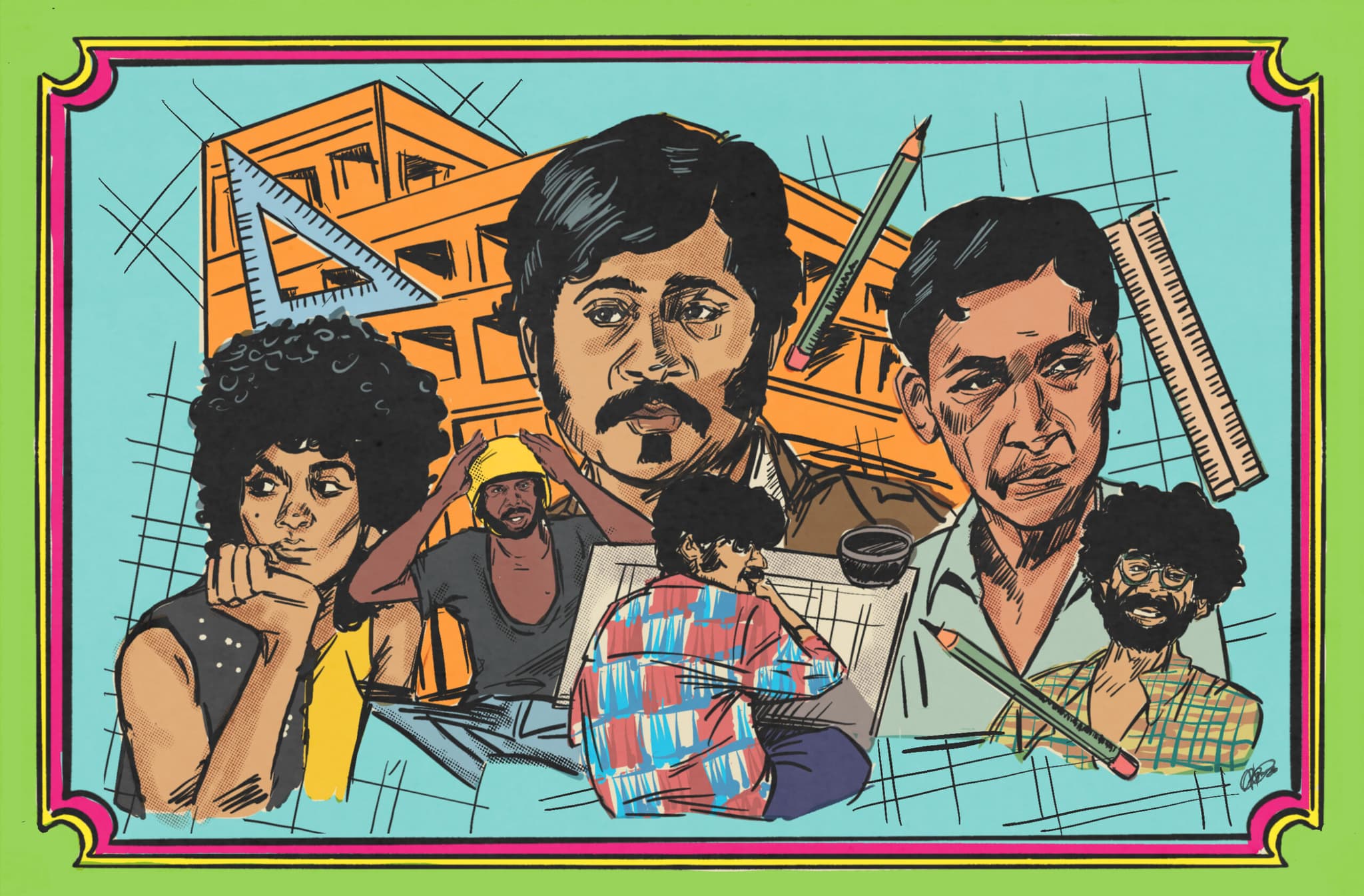
Illustration by Amanda Howell Whitehurst.
(Features)
Arundhati Roy’s Cinema of Youthful Rebellion
Issue 011
OCTOBER 21, 2026
Though best known as an author of fiction and nonfiction, Arundhati Roy first exercised her creative talents within the realm of filmmaking.
She began as an actor, as the love interest in Pradip Krishen’s 1985 feature about a government clerk, Massey Sahib, before expanding her range to screenwriting. Following Massey Sahib, Roy formed a professional and personal partnership with Krishen that spanned decades. One of the fruits of this partnership is the 1989 TV film–turned-cult-classic In Which Annie Gives It Those Ones, recently restored in a 4K digital edition by the Film Heritage Foundation.
In the late ’80s, after Roy ran through personal funds writing a historical epic 10-episode series for India’s public television channel, Doordarshan—a project ultimately scrapped—she desperately needed a win and a source of income. At the time, Doordarshan was reorienting its focus to produce low-budget made-for-television movies and told Krishen and Roy to produce a screenplay that Doordarshan would consider funding. The result is Annie, a playful, scrappy, college-set stoner comedy.
Annie centers on the titular Annie (Arjun Raina), a university student in architecture school caught in a feud with the principal, Yamdoot (Roshan Seth), and doomed to repeat his final year after being failed four times by Yamdoot. The semi-autobiographical film is grounded in Roy’s own experience as a student at the School of Planning and Architecture in Delhi, and she features in it as a supporting character, Radha, a student unafraid to question authority. Roy honors and uplifts this period of her life in Annie by painting a loving, vivid portrait of Delhi University student life in the ’70s. The student characters are “westernized,” speaking what is described as “English patois” (director Krishen helped with the subtitles for the restoration of the dialogue-heavy film). “In Delhi University slang, ‘giving it those ones’ meant ‘doing one’s usual shit,’” Roy writes in her memoir, Mother Mary Comes to Me, about the meaning behind the film’s title. Annie keeps hens in his room at the hostel, until his floormates decide to prank him by roasting them. Roy’s character Radha and her boyfriend, Arjun (Rituraj Singh), present Annie with a bunny in the hens’ place, and conspire to draw Yamdoot away during Annie’s thesis presentation. In the absence of Yamdoot and his petty grudge, the judging panel finally passes Annie, allowing him to graduate at last.
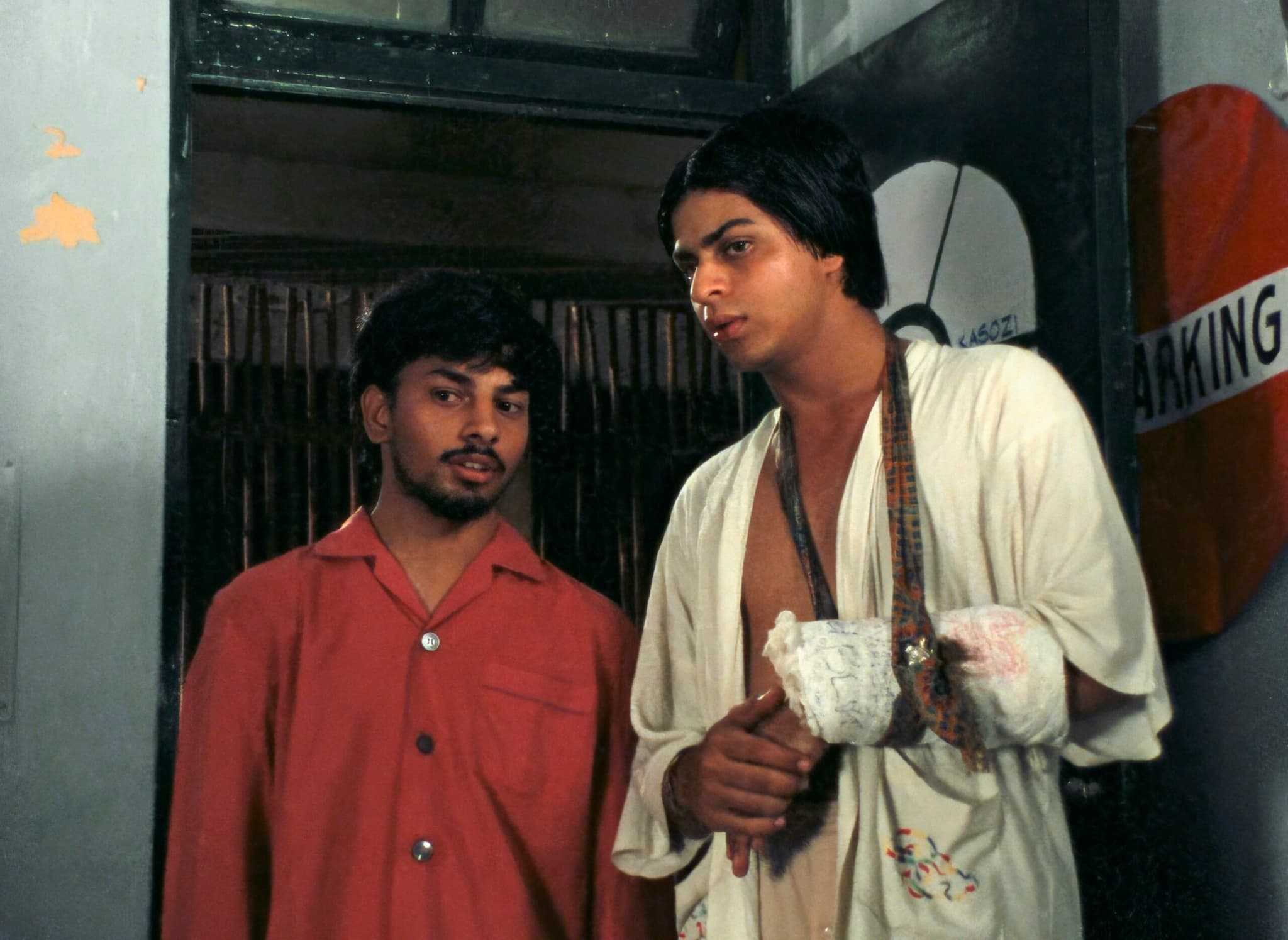
From In Which Annie Gives It Those Ones (1989), dir. Pradip Krishen, courtesy Film Heritage Foundation.
Following its TV broadcast on Doordarshan, Annie was lost in the shuffle of time. The original print was falsely rumored to have been lost in the Doordarshan archives, but the film maintained its cultural relevance through quoted and misquoted dialogue and bootleg copies recorded from the initial broadcast.
Despite its lighthearted fare and similarities with other cinematic depictions of slackerism, Annie is tethered to the ethos Roy carried into her later politically bent writings—a belief in the power of architecture and the institutions it erects, and the power of art to inform the uninformed and uplift the marginalized. While the school structure and its officials promote conformity and the design of the standard, practical government buildings, the students are unafraid to stand out, applying their radical, rebellious values of social uplift to their work in the classroom. When the instructor of a class devoted to designing sewage and waste removal systems poses a question “to the ladies” about ideal design for disposal of kitchen waste, Radha pipes up to question whether it would threaten the “gents’ virility to know about kitchens.” Later in the film, when presenting her final thesis, Radha arrives draped in a vivid red sari that she’s paired with a jaunty men’s top hat, a decision that, Roy wrote in her memoir, “fulfilled a longstanding cheap fantasy.” Fittingly, to collect the screenplay award for the movie at India’s 1989 National Film Awards, Roy arrived in her “everyday wear” rather than in a formal sari, enraging a traditional elderly bureaucrat at the ceremony (Roy has since returned the award in 2015 as part of a national “award wapsi (return)” movement of intellectuals, creatives, and athletes returning their national awards to the state in protest of rising intolerance).
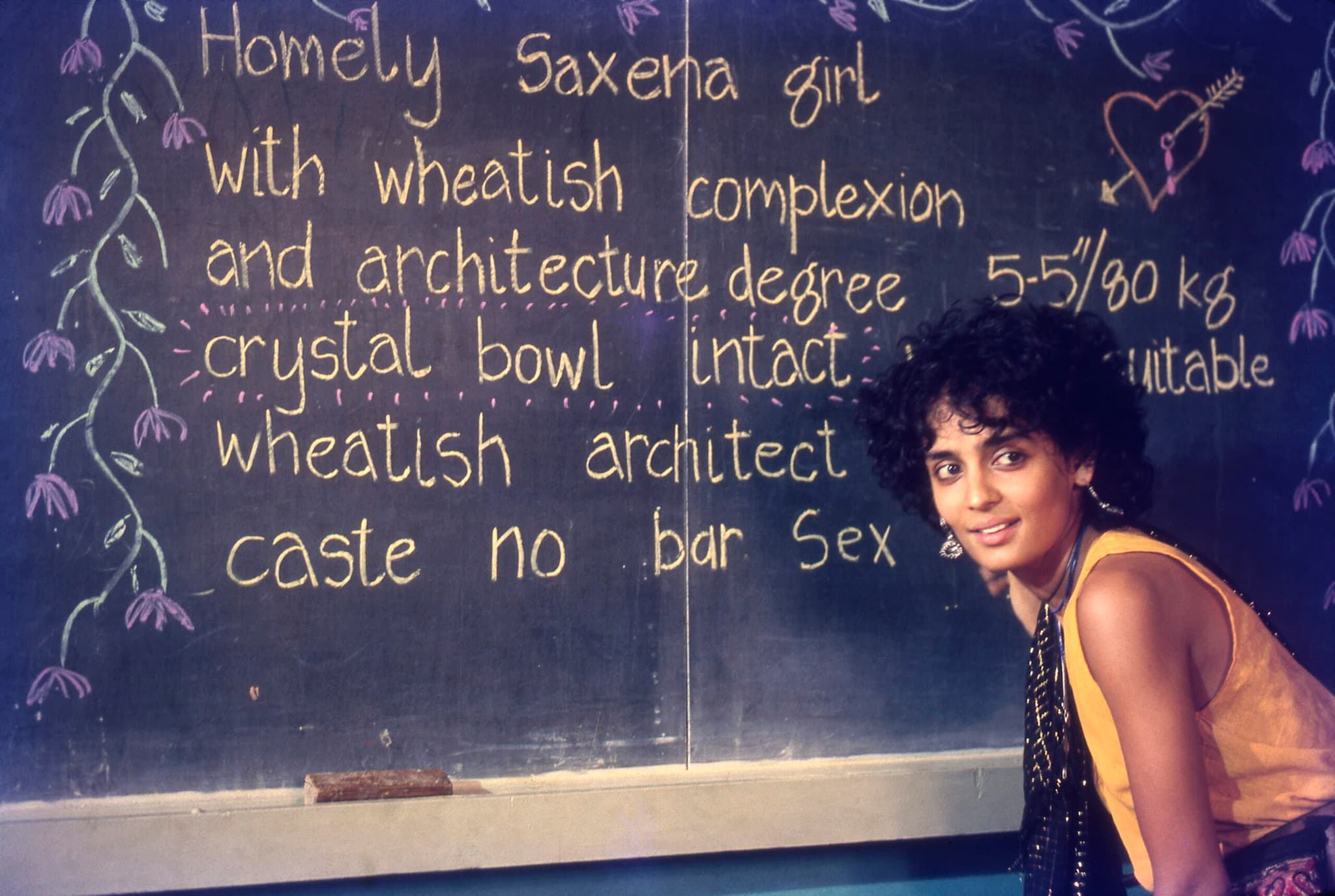
From In Which Annie Gives It Those Ones (1989), dir. Pradip Krishen, courtesy Film Heritage Foundation.
Radha’s thesis defense is an impassioned analysis of the architect’s complicity in the marginalization of the “noncitizen.” Third World cities, she argues, are divided into the city and the non-city—and those with means make use of the benefits that come from being a “citizen” and the institutions that the architect has provided for them in the form of “houses, offices, shops, roads, sewage systems.” The “noncitizen” exists “in the gaps between these institutions.” In Radha’s eyes, architects are complicit in the maintenance of social and class divides by designing and establishing these institutions and thereby “marking” the territory of the privileged. Similarly, in her own architecture schooling, Roy chose to study a housing colony, a residential development made up of “noncitizens,” and was told by instructors that she was there “to study design, not social service.”
The students in Annie—“screwballs of some sort,” as Roy describes them, who smoke profusely, have Che Guevara posters taped to their hostel walls, and make clumsy fumblings toward romance and sex—are portrayed with compassion and empathy. The soundtrack evokes the twinned axes of time captured in the film, both the 1970s setting and the sense of youthful freedom in one’s own life, featuring tracks from Jimi Hendrix, the Doors, and the Beatles. In Roy’s account of Annie’s first private screening in Delhi for the university students of the late ’80s, the students were rambunctious, raucous, and “delighted to have been deemed worthy of cinema” and “recognize themselves” on-screen. The film bears similarities to Richard Linklater’s Dazed and Confused (1993). Both films capture a particular moment in their respective 1970s settings, with Annie providing a charming representation of Indian university life.
In an interview about the restoration, Roy reflects that while she writes her nonfiction with anger, in her fiction and memoir, and in this screenplay, she “refuse[s] to give up tenderness.”2 In the same interview, Krishen clarifies that the student rebellion against the status quo that he and Roy experienced, which is depicted in the film, is filled with “hope and celebration,” with students reveling in being themselves while refusing to conform to institutional desires and guidelines. Roy describes her own student experience as her first time experiencing “radical freedom.” She would have entered architecture school during the Emergency, a period spanning from 1975 to 1977 marred by oppressive authoritarian policy that crippled India’s burgeoning democracy by suspending civil liberties and freedom of the press. Lower income “noncitizens” in Delhi were disproportionately targeted by these policies, with many coerced into sterilization through cash incentives intended to exploit them, while others were physically displaced from their previous settlements and homes.
Roy is clear that while “some wonderful, deeply political films were being made about the state of the country, violence against women, and the feudalism [India] couldn’t seem to shake off . . . Annie was nothing like them.” The film’s depiction of joy, freedom, and opposition in the immediate aftermath of a period of political suppression is a radical act. The students it depicts are devoted to exercising their power of freedom of speech and refuse to be slotted into positions of enforcing boundaries between the citizen and noncitizen through their methods of design. Throughout her career, Roy has continued to unapologetically exercise her freedom of speech despite facing accusations of antinationalism and sedition, carrying the ethos and principles of Annie with her along the way. One of the reasons Annie’s legacy endures is perhaps precisely because it offers a vision of the future glimpsed through the students’ eyes, a spot of brightness in the midst of political uncertainty—a rebellion that’s buoyant, rambunctious, and real.
1. Naman Ramachandran, “Arundhati Roy and Pradip Krishen’s Cult 1989 Indian Film ‘In Which Annie Gives It Those Ones’ Gets Second Life With Film Heritage Foundation Restoration at Berlinale,” Variety, February 15, 2026, https://variety.com/2026/film/festivals/arundhati-roy-pradip-krishen-annie-restoration-berlinale-1236663699/.
2. Anushka Halve, “In Which Annie Gives It Those Ones, Again: Arundhati Roy and Pradip Krishen on Taking Their Film to Berlinale 2026,” Hollywood Reporter India, January 30, 2026, https://www.hollywoodreporterindia.com/features/insight/berlinale-2026-arundhati-roy-and-pradip-krishen-on-taking-in-which-annie-gives-it-to-those-ones-to-the-festival.
Share
Related