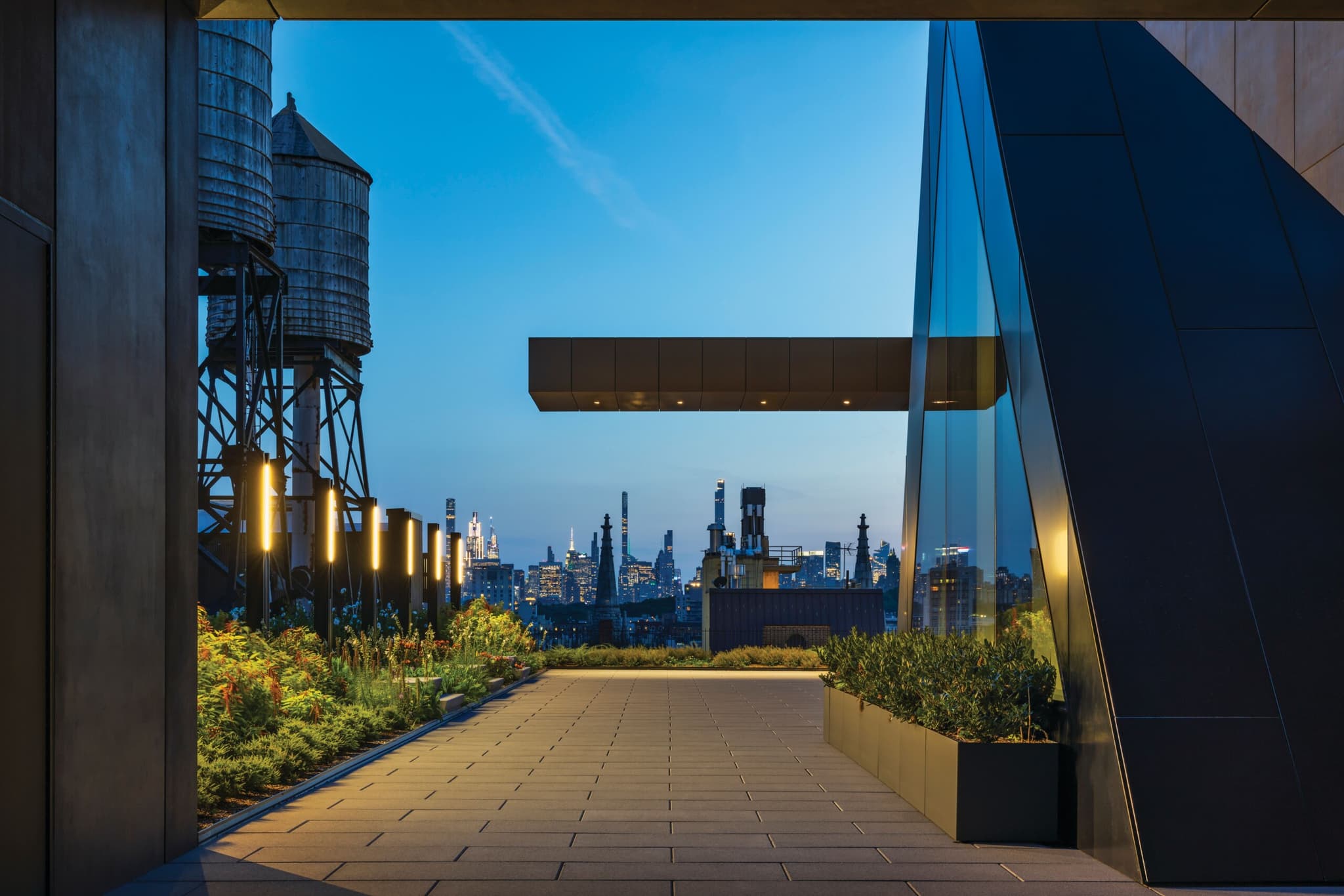
The Studio Museum in Harlem’s new terrace, photo by Albert Vecerka/Esto, courtesy Studio Museum in Harlem.
(Features)
The Studio Museum Steps into a New Era
Issue 010
MAY 20, 2026
After seven long years of renovations and innovations, the Studio Museum reopened last November. David Hammons’s African American Flag—red, black, and green, symbolizing Black pride and liberation—waves proudly out front, signaling the building’s unequivocal message: here is a refuge dedicated to Black life and cultural production.
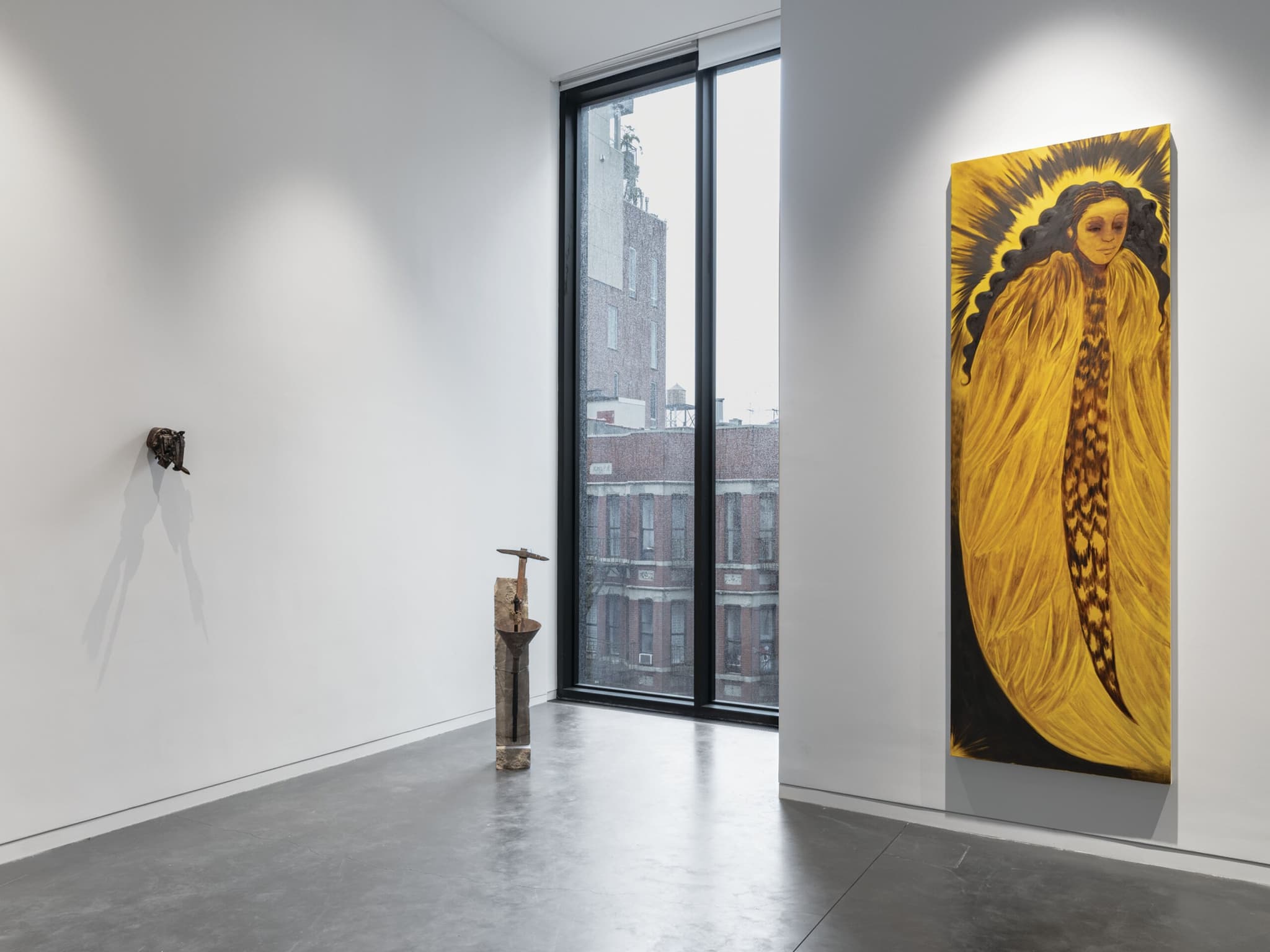
From Now: A Collection in Context, Studio Museum in Harlem, 2025, photo by Kris Graves, courtesy Studio Museum in Harlem.
Designed by Adjaye Associates in collaboration with executive architect Cooper Robertson, the building’s dark gray facade consists of precast concrete and glass with a sandblasted, polished finish. Its many rectangular window frames, of varying sizes and stacked atop one another, recall Harlem’s iconic brownstones. The frames offer multiple views of the building’s interior, and from inside museumgoers look out onto the bustling activity of 125th Street. The exterior contains four niches for outdoor sculptures and installations, also visible from the street. It is a building that beckons to all who are curious to come inside.
The Studio Museum opened in 1968—the zenith of the Civil Rights and Black Arts movements, the year that marked a watershed moment in American racial politics. Tensions were high; the assassination of Martin Luther King Jr. jolted the nation. Six months later, Tommie Smith and John Carlos raised their fists during their Olympic medal ceremony as a salute to Black power. It was a year of protest and freedom dreaming in which thousands of women and men marched across the country to demand reform in a society they deemed unjust.
Founded by a group of artists, community organizers, and philanthropists, the Studio Museum began as a humble loft at 2033 Fifth Avenue, on the third floor of an industrial building that once housed a dry goods warehouse. At 10,000 square feet, its space was small but its ambitions large. Black artists were severely underrepresented in museums, and the museum’s founders envisioned a place where Black artistry would be elevated and no longer sequestered to the margins. Founders Eleanor Holmes Norton, Carter Burden, Charles E. Inniss, Campbell Wylly, Betty Blayton-Taylor, and Frank Donnelly recognized Harlem’s rich cultural history and status as the Black Mecca and saw it as an ideal home for an institution devoted to Black art.
The Studio Museum opened without a historic collection or major endowment, and its founders acknowledged the need for Harlemites to endorse and participate in its development. In a text written by the museum’s founding committee, the museum recognized that there would be “no point in attempting [fundraising] if the community does not want a Museum,” and made plans to meet with local civic leaders and groups to “learn the community’s opinion.” Included in the museum’s original vision was “classroom space for teaching children as well as adults” and “a training program in museum work for young people from the community” that would “staff as many Negroes as possible.”¹ The museum would be both hyperlocal and diasporic, a link between the Black community and art world at large. In 1969, the first full year of programming, the museum showcased a wide range of exhibitions that reflected this ethos, including Afro Haitian Images and Sounds Today, The Black Panthers, 10 Black Artists from Boston, and Harlem Artists ’69. In July 1968, the museum launched its Film Unit, a workshop that offered free filmmaking courses and resources to students from Harlem and New York City. Active for two years, the Film Unit’s participants included filmmaker Julie Dash, who enrolled as a teenager. Dash’s involvement in the program sparked her interest in pursuing filmmaking as a career. Exhibitions and programs such as these remain an integral part of the renovated museum.
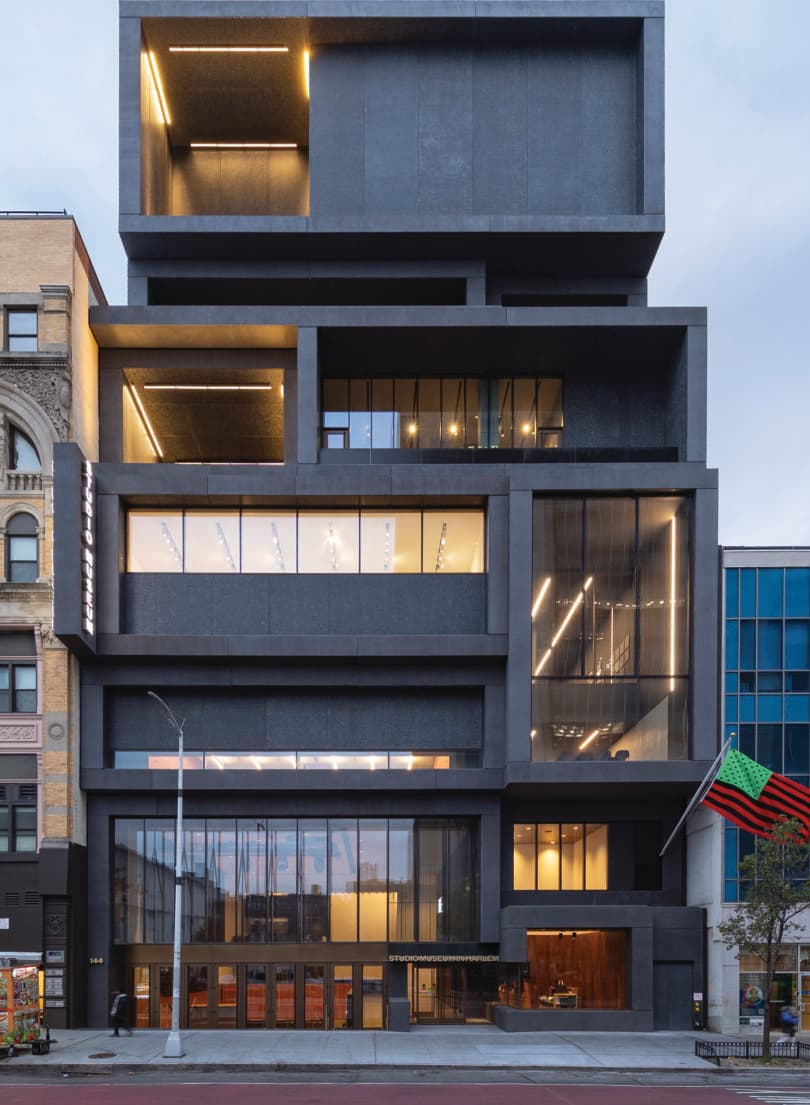
Exterior view of the Studio Museum in Harlem’s new building, 2025, photo by Albert Vecerka/Esto, courtesy Studio Museum in Harlem.
Like the Smithsonian National Museum of African American History and Culture, also conceptualized by Adjaye Associates, the Studio Museum’s renovated design is distinct, precise, and complex. Three principal elements drive the museum’s design: the sanctuary, the stoop, and the street—references to Harlem’s distinct architectural features.
The sanctuary is an homage to Harlem’s legendary African American churches, which have historically functioned as places of respite and gathering for their members—such as The Abyssinian Baptist Church, St. Philip’s Episcopal Church (whose building was redesigned by Vertner Woodson Tandy and George Washington Foster, among the first practicing African American architects in New York), and Mother African Methodist Episcopal Zion Church (the oldest African American church in New York City)— expressed through a lightwell and gallery with vaulted ceilings of double height.
The stoop, that irreplaceable commons where community is made, functions as the primary point of entrance to the museum—an inverted wood-paneled staircase used for lectures, screenings, and informal gatherings. Its threshold is porous; the glass doors leading to the stoop open directly onto the street. The museum is not a gated and sealed echo chamber; life flows freely through its walls. These architectural features recall elements of the museum’s former spaces: the informality of the loft space at 2033 Fifth Avenue and the openness of the previous building’s mezzanine.
The presence of wood—pine, walnut, and ebonized oak—throughout the building adds warmth that counters the brutalism² of the central staircase’s sharp, jagged edges and imposing presence. A rooftop terrace, with landscape design by Harlem-based Studio Zewde, overlooks 124th and 125th Streets. The window in the education room, designed with children in mind, is set lower to the ground to prioritize their view.
An incubator for Black art, the Studio Museum has been pivotal in launching the careers of then-emerging and now-lauded artists, such as Kerry James Marshall, Simone Leigh, Julie Mehretu, Sanford Biggers, Alison Saar, Adam Pendleton, and Mickalene Thomas. It has hosted a number of innovative and legendary solo and group exhibitions—including The World of Bob Thompson (1978), Harlem Heyday: The Photography of James Van Der Zee (1982-83), Tradition and Conflict: Images of a Turbulent Decade, 1963–1973 (1985), Freestyle (2001), and Alma Thomas (2016)—and trained generations of scholars, curators, and cultural workers.
The Studio Museum expanded quickly in its first decade, establishing its permanent collection and artist-in-residence program, a residency that offers a stipend, studio space, and a culminating exhibition to artists of African and Afro-Latinx descent. “The artist-in-residence program was my entrée into the New York art world,” reflects Sanford Biggers, an alum of the program. “It gave me the confidence to pursue the direction I was going in and fostered the right environment for me to expand on my ideas and better understand their context within the larger field of artistic production.”
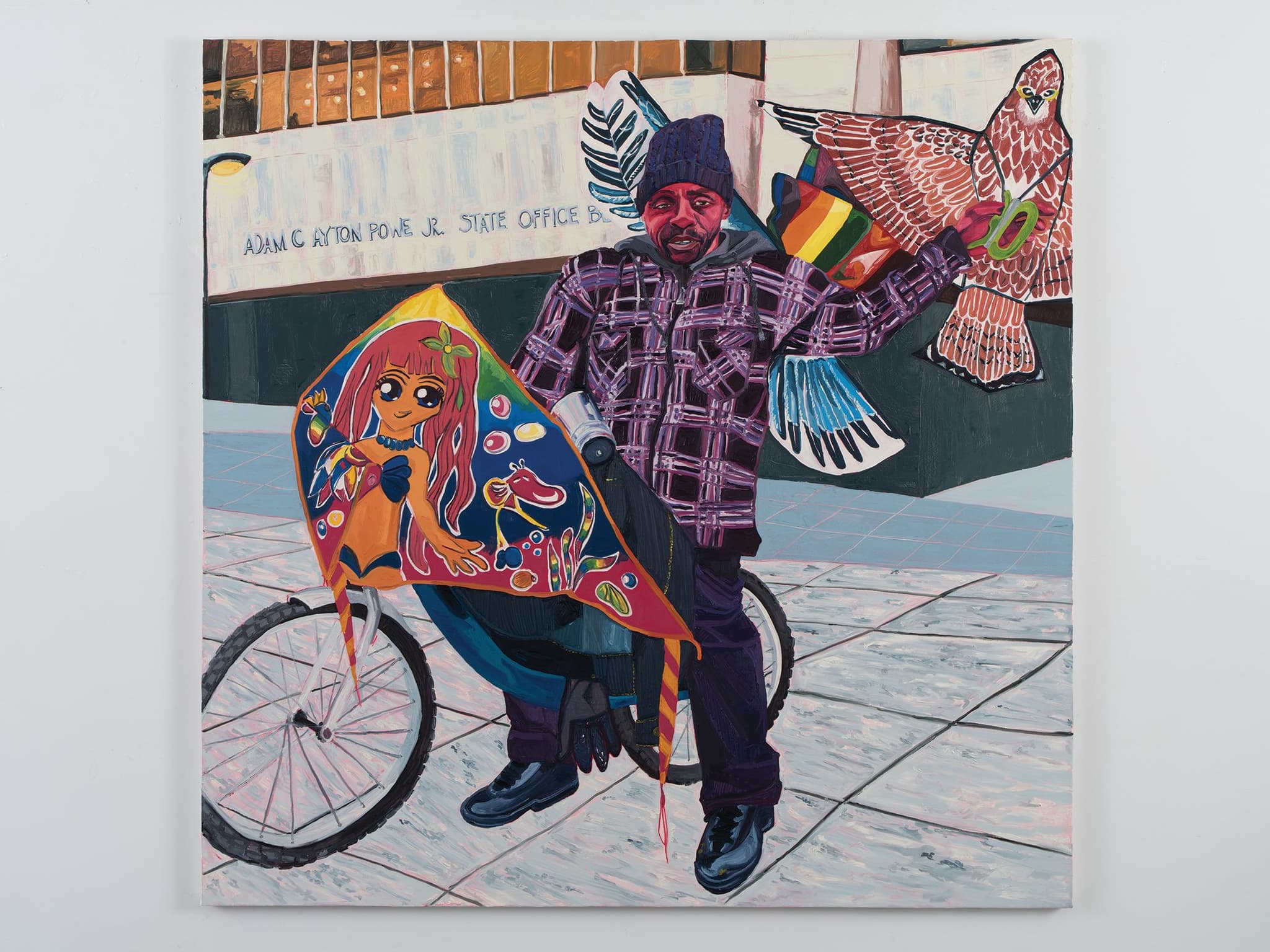
Jordan Casteel, Kevin the Kiteman (2016), oil on canvas, 78 × 78 in, photo by John Berens, courtesy Studio Museum in Harlem.
In 1979, after many efforts to find a new location, it received, as a gift from the New York Bank of Savings, a 60,000-square-foot neoclassical commercial building at 144 West 125th Street, its current location. Redesigned by architect J. Max Bond Jr., the expansion included galleries, a gift shop, workshops, artist studios, and space for the museum’s growing collection and archives. In 1992, a sculpture court designed by Fred Bland of Beyer Blinder Belle was installed in a vacant lot at 142 West 125th Street.
The museum continued to flourish under the leadership of directors Dr. Mary Schmidt Campbell, Kinshasa Holman Conwill, Dr. Lowery Stokes Sims, and Thelma Golden. Dr. Campbell spearheaded the museum’s move to 144 West 125th Street. Under Conwill, the Studio Museum became the first institution dedicated to artists of African descent to receive accreditation from the American Alliance of Museums. Dr. Sims, who was appointed executive director of the museum in 2000, has expanded the art historical canon by championing the work of underrepresented and overlooked artists. Golden, the museum’s current chief curator, is a powerhouse whose name has become synonymous with the Studio Museum. By the mid 2010s, the museum had fulfilled its original intent to “become the most important institution in the world of Black artists.”³
Under Golden’s leadership, the museum had outgrown its space once more and needed more room to showcase its ballooning permanent collection and support the artist-in-residence program. The artist-in-residence program has gone on to include more than 150 alumni and some of the most widely exhibited, collected, and awarded Black contemporary artists, including Kehinde Wiley, Njideka Akunyili Crosby, and Wangechi Mutu. Six alumni have represented the United States at the Venice Biennale, five have won MacArthur “genius” grants, and dozens have had solo exhibitions at major international museums.
Spanning seven floors and 82,000 square feet, the Studio Museum can properly showcase its collection of nearly 9,000 works. It inaugurated its reopening with four exhibitions and two newly commissioned artworks by Camille Norment and Christopher Myers. One exhibition, Tom Lloyd, is the first institutional survey dedicated to the artist, educator, and activist whose kinetic light sculptures were featured in the museum’s opening exhibition in 1968. Lloyd’s work, abstract and conceptual rather than representational, signaled the museum’s desire to expand how Black art would be defined and understood.
In 1986, artist Houston E. Conwill installed The Joyful Mysteries at the Studio Museum, a collection of seven sealed time capsules he described as “testaments to the future” that contain messages from seven notable Black Americans, including visual artist Romare Bearden and author Toni Morrison. The capsules were buried in the museum’s sculpture garden and unearthed during its renovation. They are now on display and will be opened in September 2034, 50 years after their creation. They will emerge in a location that is also a testament to the future, a living monument to Black artistic expression and community stewardship.
When the capsules are opened, the new iteration of the Studio Museum will approach its 10th anniversary. As diversity, equity, and inclusion programs are being dismantled and the Trump administration targets institutions that center and celebrate queer, disabled, and non-white identities (among them, the American Women’s History Museum, the Smithsonian, and the National Museum of African American History and Culture), it’s impossible to say what kind of world they will surface in. No matter what, the messages inside, addressed to the Black youth of the future, will offer indispensable wisdom. May they remind us that the dreams and visions our elders left behind must be protected, for they are never guaranteed.
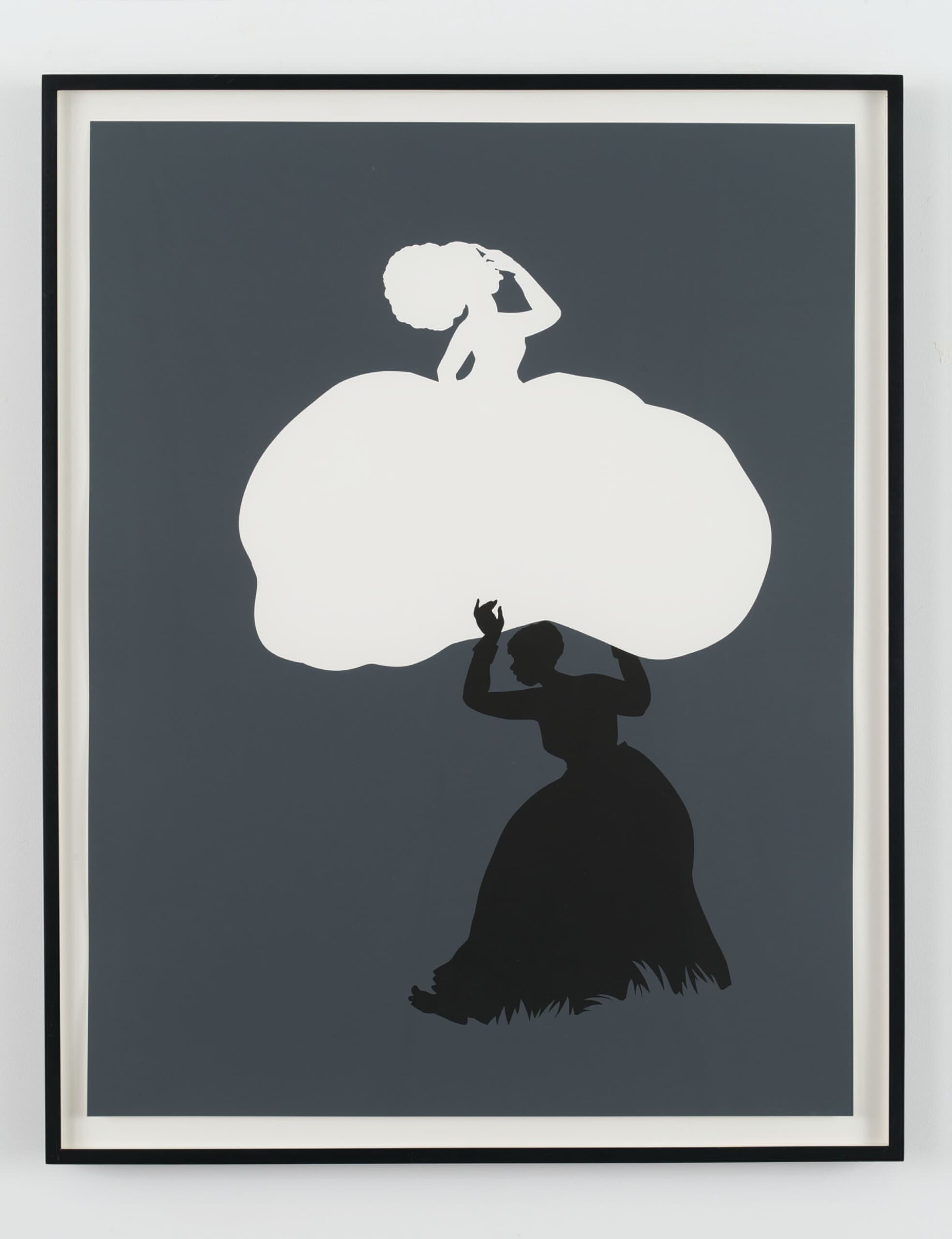
Kara Walker, The Emancipation Approximation (scene 18) (1999-2000), silkscreen on paper, 44 × 34 in., edition 5/25, photo by John Berens, courtesy the artist.
- Committee for the Harlem Museum, Outline for Speakers, September 9, 1966.
- Francesc Zamora, “Architecture 101: What is Brutalist Architecture?,” Architizer, December 12, 2024, https://architizer.com/blog/inspiration/stories/architecture-101-what-is-brutalist-architecture/.
- Philosophy Committee of the Studio Museum, Minutes from the meeting held at the home of Mrs. Lynn Hofer, September 25, 1969.
Share
Related