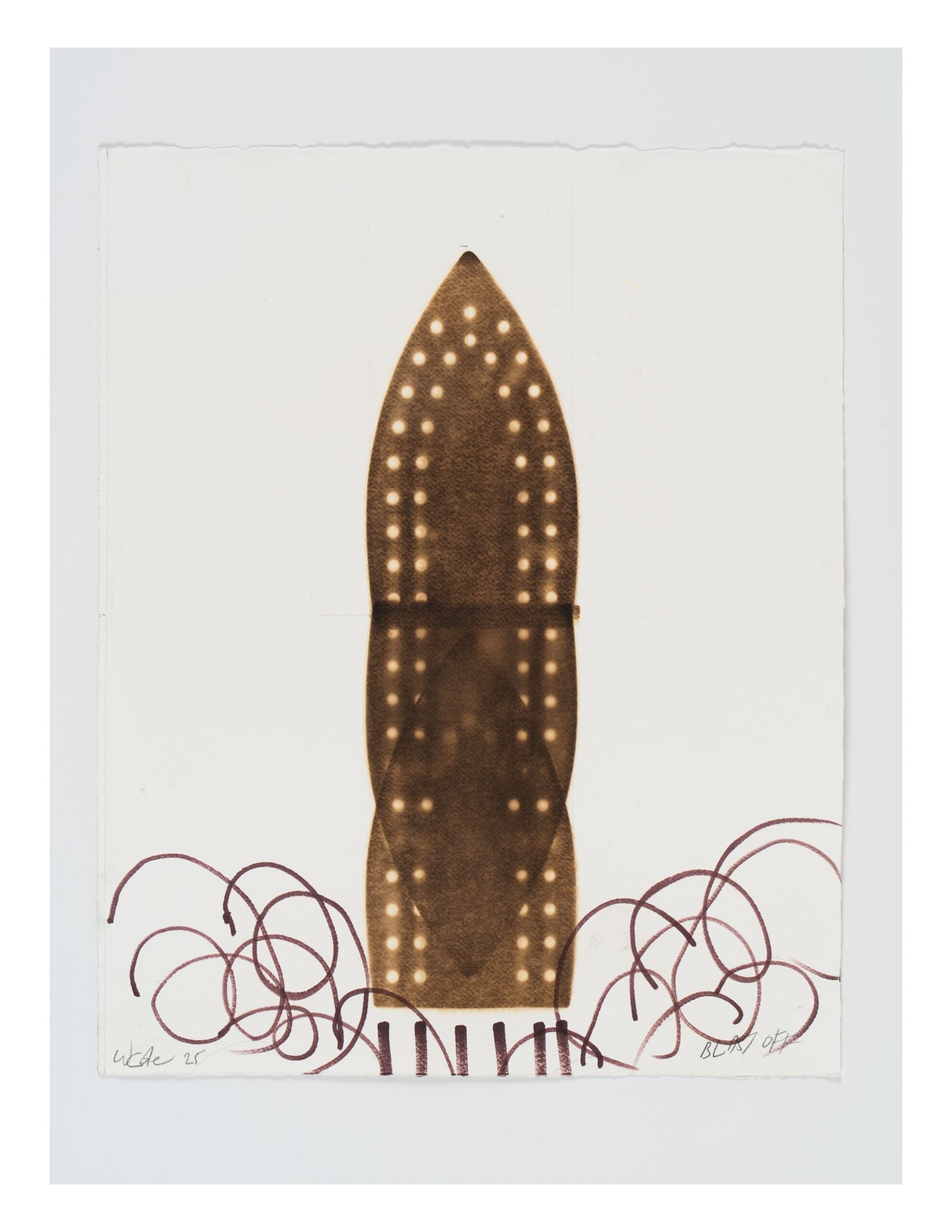
Willie Cole, Blast Off!! (2025), scorch on paper, 20” x 16”, photo by John Berens, courtesy Willie Cole.
(From the Editor)
Letter from the Editor
Issue 010
MAY 20, 2026
This is our 10th issue of Seen, and this year we mark BlackStar Film Festival’s 15th anniversary. Amidst the defunding of public media, the rise in anti-DEI policies, and the tech oligarchy’s increasing ownership of everything we consume, from food to entertainment, we are here with something to celebrate.
It’s good to look back at a moment like this, to assess, reflect, and remember how we got here. BlackStar’s festival director (and former managing editor of Seen), Nehad Khader, writes about some of the festival’s most unforgettable screenings, films, and moments. We also hear from Roya Rastegar, who reflects on BlackStar’s evolution from a film festival to a robust organization that includes a seminar, this journal, and curatorial screenings throughout the world. In her poetic piece, Rastegar writes, “BlackStar insists that the most radical gesture may be the creation of a space where people are not required to perform or prove their humanity. The questions here are not how cinema will circulate but who it is accountable to.”
Arthur Jafa’s 2016 video essay Love Is the Message, the Message Is Death—which had its festival world premiere at BlackStar—catapulted him into a new stratosphere of success and acclaim as a visual artist. But as many know, his artistic roots go back to his work as a cinematographer on Daughters of the Dust (1991). In a candid conversation with Roísín Tapponi, Jafa talks about his return to cinema, directing his first feature film at the age of 65, his kinship with Jean-Michel Basquiat, and coming to terms with his ambition.
It’s been 30 years since Cheryl Dunye’s The Watermelon Woman—a comedic critique of Hollywood’s racist stereotypes set in Philadelphia and the first US feature to be directed by a Black lesbian. Dunye has gone on to become a prolific television director and make more feature films, but in her essay for Seen, she returns to her directorial choices in The Watermelon Woman. She considers how this film, made with little money and time, has become queer canon—a touchstone for subsequent generations of Black queer filmmakers and audiences, in particular Black lesbians and studs.
A movie that is certain to leave its mark is Bouchra (2025), Meriem Bennani’s moving debut feature that combines documentary and narrative techniques to tell the story of a queer Moroccan coyote filmmaker and her cardiologist mother. Shot in 3D animation and written and directed with Orian Barki, this loosely autobiographical film tells the story of how a mother and daughter deal with their unresolved tensions. Samia Labidi’s profile looks at how Bennani’s work refuses categorization or genre and simultaneously feels capacious in its joy, grief, exile, tenderness, and rage. Labidi writes that for Bennani, “Imagination is not escape. Imagination is the practice that keeps us capable of collective transformation.”
This issue wouldn’t be in your hands without Leo Brooks’s art direction, Akili Z. Davis’s thoughtfulness, Shauna Swartz’s attention to detail, and Akua Maat, Autumn Valdez, Pablo Alarcon Jr., Kavita Rajanna, Camille Acker, and Yasmine Espert. Most importantly, Seen would not exist without the vision of Maori Karmael Holmes. She’s always been a step ahead of the times because she knows who’s preceded her time, as well as the artists whose names we don’t know and should. Her knowledge, her curiosity, and her kindness have gotten us to our 10th issue, and for that, I’m grateful.
Share
Related